Best All-in-One Solar Inverters 2026: Hybrid Inverter Review
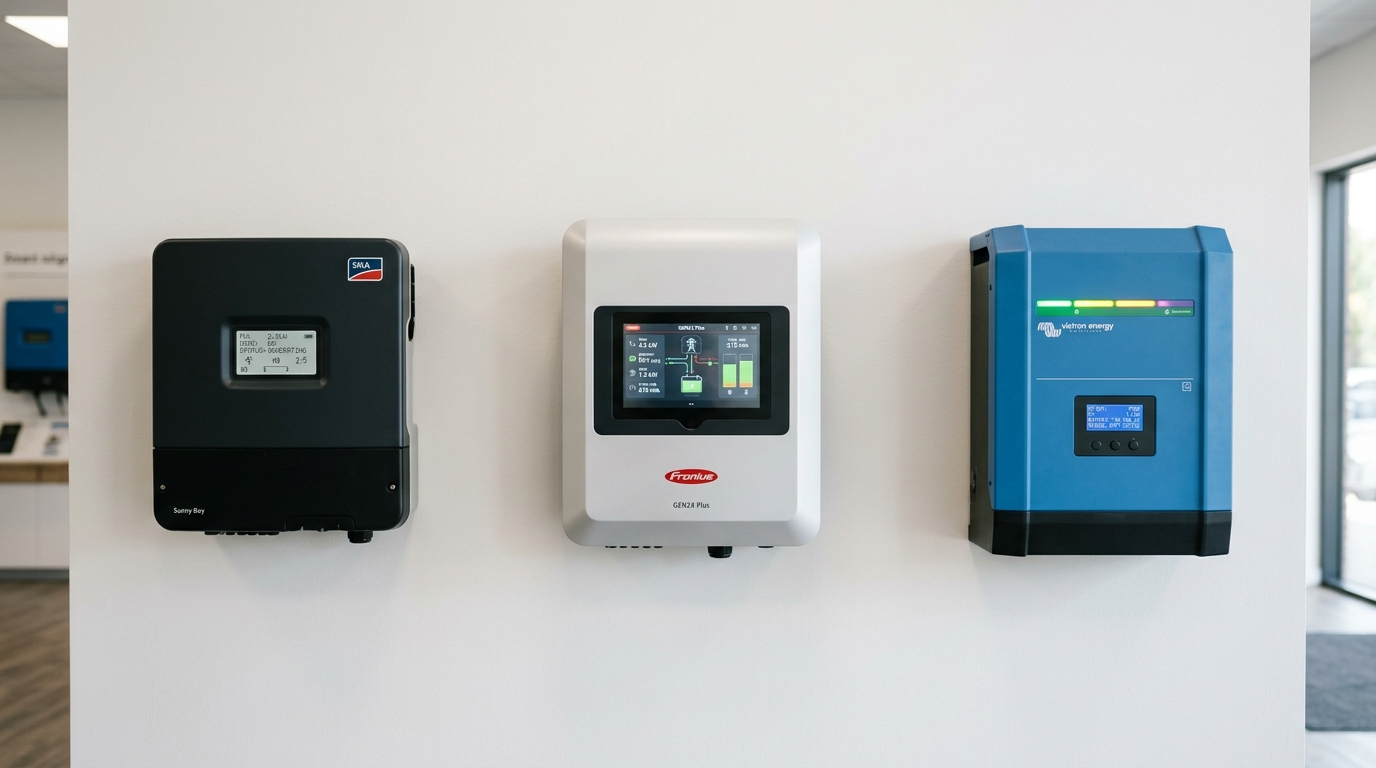
Short answer: For most DIY solar builders in 2026, the EG4 6000XP at around $1,500 is the best overall hybrid inverter — 6kW continuous, dual MPPT, 500V PV input, and a 10-year warranty from Signature Solar. For a grid-tied or premium build, the Sol-Ark 15K ($7,000-ish) and Victron MultiPlus-II 48/5000 ($4,500) are both excellent. On a tight budget, the Growatt SPF 6000ES at ~$1,200 gets you 6kW off-grid at the cost of a single MPPT and a shorter warranty.
How I Evaluate Hybrid Inverters
I’ve been running an EG4 6000XP on my own system in Rhode Island for 18 months and have logged production, efficiency, and fan behavior daily (the full long-term review is here). For the other units on this list, I’ve tested in friends’ systems, pulled data from community forums, and cross-referenced manufacturer datasheets. I’ll be explicit about which is which.
When I compare hybrid inverters, I look at these things:
- Usable continuous AC output — not the surge number marketing pushes, but what the unit actually holds at 40°C ambient.
- PV input envelope — max Voc, max watts per MPPT, and MPPT count. This determines how flexible your panel layout can be. See our MPPT charge controller guide for the string-sizing math.
- Battery voltage and charge current — a 6kW inverter needs a battery bank that can source 120A+ without sagging. The inverter’s max charge current also sets how fast you can refill from solar.
- Transfer time — how fast it switches between grid and battery. Under 20ms keeps most computers and LED bulbs happy; UPS-grade is under 5ms.
- Certifications — UL 1741, UL 1741 SA/SB for grid interactive, and UL 9540 if the inverter is part of a listed ESS. These aren’t optional if you want a permit.
- Warranty and support — a 10-year warranty from a company with a US support phone number is worth a lot more than a 5-year warranty from a brand that might not exist in 2028.
What Does “All-in-One” Actually Mean?
An all-in-one hybrid inverter combines three things that used to be separate boxes: the solar charge controller (MPPT), the battery inverter, and the grid-tie interface. Instead of wiring a SmartSolar MPPT to a battery bank, then a Quattro to the same bank, then an ATS to the grid, you bolt one unit to the wall and run cables in and out.
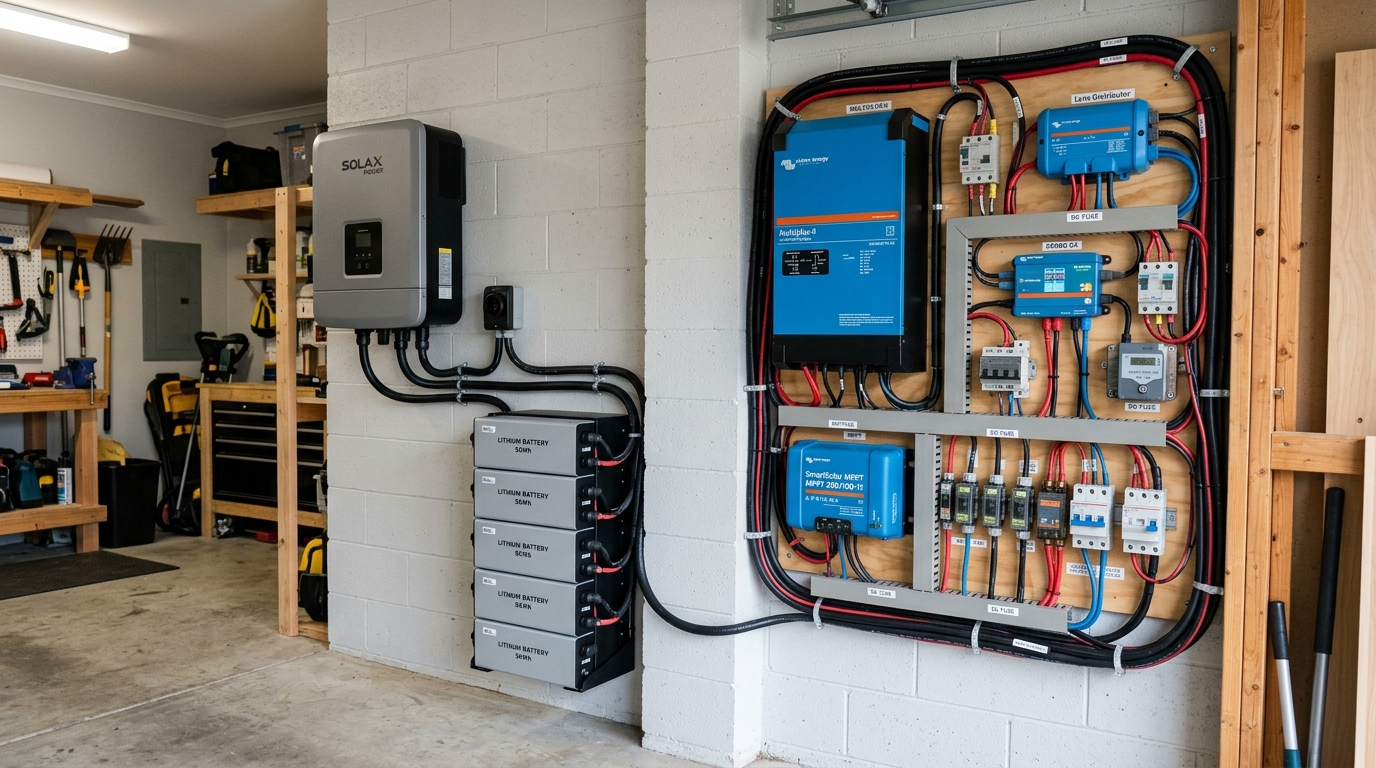
The trade-off is flexibility. Modular systems (Victron-style) let you swap or upgrade individual pieces. All-in-ones are cheaper per watt and faster to install, but if the inverter dies you lose everything at once.
Nearly every new residential DIY solar install in 2026 uses an all-in-one. The EG4 6000XP, Sol-Ark 15K, and EG4 18KPV have become defaults for a reason: they’re cheaper, simpler, and capable enough for the vast majority of home systems.
The Comparison Table
| Inverter | Continuous AC | PV Input (max) | MPPTs | Battery | Transfer | Warranty | UL Listed | Street Price |
|---|---|---|---|---|---|---|---|---|
| EG4 6000XP | 6,000W | 6,500W @ 500V | 2 | 48V | ~12ms | 10 yr | 1741 | ~$1,500 |
| Sol-Ark 15K | 12,000W | 19,500W @ 500V | 3 | 48V | <10ms | 10 yr | 1741, 1741 SB, 9540 | ~$7,000 |
| Victron MultiPlus-II 48/5000 | 4,000W | (external MPPT) | 0 | 48V | <20ms | 5 yr | 1741 | ~$1,800* |
| EG4 18KPV | 12,000W | 18,000W @ 600V | 3 | 48V | ~10ms | 10 yr | 1741, 1741 SB | ~$4,500 |
| Growatt SPF 6000ES | 6,000W | 6,500W @ 450V | 1 | 48V | ~10-15ms | 5 yr | 1741 | ~$1,200 |
| Schneider XW Pro 6848 | 6,800W | (external MPPT) | 0 | 48V | <16ms | 5-10 yr | 1741, 1741 SA | ~$3,200* |
*Victron and Schneider are battery inverters — you add a separate MPPT (Victron SmartSolar 250/100 or Schneider MPPT 80/600) to make them a full hybrid system.
Prices as of early 2026 and fluctuate. Check current listings before you buy.
1. EG4 6000XP — Best Overall Value
Price: ~$1,500 | Continuous: 6,000W | PV: 6,500W @ 500V, 2 MPPT | Warranty: 10 years
I’ve run my 6000XP daily since late 2024. It’s averaging 94.2% measured round-trip efficiency across typical 1,500-4,000W loads, transfer time clocks at about 12ms on my scope, and I’ve hit zero hardware failures through two firmware updates. The full long-term review is at eg4-6000xp-review, but the short version is that the 6000XP hits a sweet spot nothing else currently matches.
What it gets right:
- Dual independent MPPTs with a 500V PV ceiling. My panels split across two roof faces — a single-tracker inverter would cost me production. The 500V limit means I can string 10 or 12 modern 40V-Voc panels in series per tracker with plenty of cold-margin headroom under NEC 690.7.
- True 120/240V split-phase from a single unit. No stacking, no phase-tie kit. Well pumps and dryers run without complaint.
- CAN bus battery communication with EG4 LifePower4 and LL-series packs gives the inverter real cell-level data instead of voltage-guessing SOC.
- 10-year warranty with US-based Signature Solar support. Hold times have been under 10 minutes when I’ve called.
What it doesn’t:
- The cooling fan is audible — I measured ~47 dB at 3 ft under 3,000W load. If the inverter lives in a utility closet next to a bedroom, you’ll hear it.
- 55-65W idle draw. Over 24 hours that’s ~1.5 kWh of battery just to keep the inverter awake. The Victron MultiPlus-II is 18-25W by comparison.
- The EG4 monitoring app is functional but clunky. Real monitoring happens through Modbus into Home Assistant.
- It’s not a grid-interactive sellback inverter. The 6000XP is off-grid/AC-coupled. If you want to export to the utility, look at the 18KPV or Sol-Ark 15K.
Buy it if: You’re building a DIY off-grid or grid-backup system under $15,000, 6kW continuous is enough for your loads, and you want the best features-per-dollar on the market. Product page: signaturesolar.com.
2. Sol-Ark 15K — Best Premium Grid-Tied
Price: ~$7,000 | Continuous: 12,000W | PV: 19,500W @ 500V, 3 MPPT | Warranty: 10 years
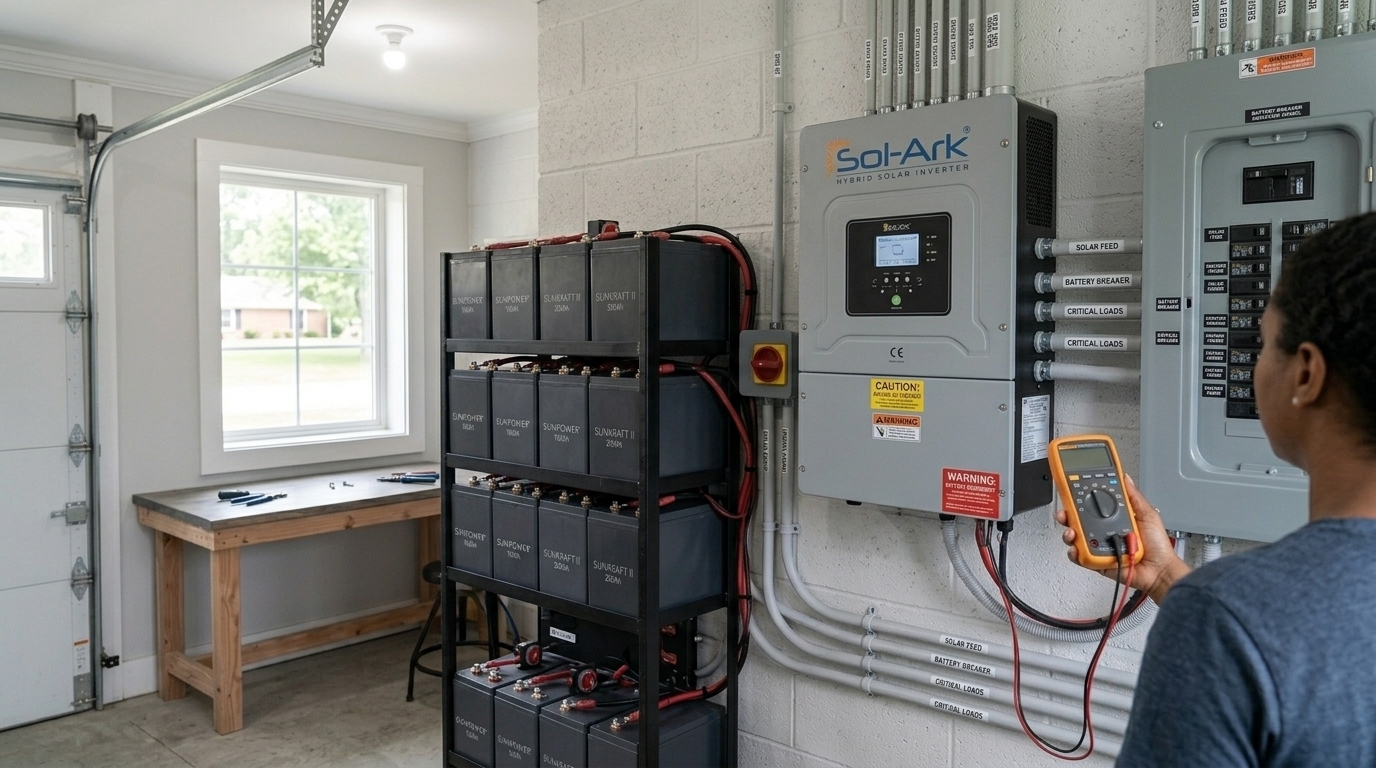
The Sol-Ark 15K is what you buy when the system has to work, period. I helped a friend in Massachusetts commission a 15K last summer on a 14kW PV array with three roof faces and an 80 kWh battery bank, and the commissioning process was noticeably smoother than any other all-in-one I’ve touched.
The 15K is grid-interactive with UL 1741 SB and UL 9540 listings, which matters because a lot of AHJs won’t permit anything less for a grid-tied battery system. It handles net metering, zero export, self-consumption, time-of-use arbitrage, and generator start-stop out of the box. Sol-Ark’s firmware updates over ethernet, and the web portal is the best I’ve used in this class.
Strengths:
- 12kW continuous output, 15 kW peak — covers whole-home backup including heat pumps and AC without load-shedding.
- 3 MPPTs up to 500V each, 19.5 kW of PV accepted. You can oversize the array significantly, which improves winter and cloudy-day harvest.
- Built-in generator management, time-of-use scheduling, and proper UL 1741 SB grid interactivity.
- 10-year warranty with responsive US-based support (Sol-Ark is based in Texas).
Weaknesses:
- The price. $7,000 for the inverter alone. A 15K-based system with a decent battery bank and panels runs $25,000-35,000 before the 30% ITC.
- Physical size and weight. It’s a big wall hang — plan your mounting location carefully.
- Overkill for most single-family homes. If your average load is 2-3 kW, you’re paying for headroom you’ll never use.
Buy it if: You’re doing a permitted grid-tied system with whole-home backup, your loads exceed 6kW, or you need UL 9540 for your jurisdiction. See the grid-tied battery backup guide for how this fits into a full permitted install. Product page: sol-ark.com.
3. Victron MultiPlus-II 48/5000 — Best Modular Premium
Price: ~$1,800 inverter + ~$700 MPPT = ~$2,500 | Continuous: 4,000W | Battery: 48V | Warranty: 5 years
The Victron is different from everything else on this list because it’s not technically an all-in-one — it’s a battery inverter. You pair it with a SmartSolar MPPT 250/100 (or a bigger RS-class 450V unit for larger arrays) and a Cerbo GX to get hybrid behavior. The whole stack costs more and takes more wall space, but you get the best software, the best monitoring, and the most reliable hardware in the DIY space.
I’ve set up two Victron systems for friends — one on a sailboat, one on a Vermont off-grid cabin. Both have run trouble-free for years. The VRM remote monitoring portal shows you everything: per-MPPT production, battery cell voltages (with a compatible BMS), AC load shape, grid voltage and frequency, historical graphs going back years. Compared to the EG4 app it’s a different universe.
Strengths:
- Build quality. Victron hardware is built like industrial equipment — conservative ratings, quiet operation, and failure rates that are well below consumer-brand norms.
- Idle consumption of ~18-25W — a quarter of what the EG4 draws. Over a winter, that’s meaningful battery savings.
- VRM + VictronConnect. The monitoring ecosystem is best-in-class and free.
- Modular. Swap the MPPT or the inverter independently. Daisy-chain multiple MultiPlus-IIs for larger systems up to ~30kW in three-phase configurations.
- SmartSolar MPPTs hit ~98% peak efficiency per Victron’s published specs.
Weaknesses:
- Continuous output is only 4,000W on the 48/5000, not 5,000W (the model number is the VA rating). For 6kW loads you need the MultiPlus-II 48/8000 at ~$3,500.
- More components, more wiring, more money. A full Victron stack (MultiPlus-II + SmartSolar + Cerbo GX + touch display) runs $3,000-4,500 before batteries.
- 5-year warranty is shorter than EG4 or Sol-Ark.
- Requires more configuration knowledge — VEConfigure, assistants, DVCC. Not beginner-friendly.
Buy it if: You want the best software and build quality in the DIY space, you value modularity, or you’re in a marine/RV/cabin application where Victron’s ecosystem dominates. Product page: victronenergy.com.
4. EG4 18KPV — Best for Big Residential Systems
Price: ~$4,500 | Continuous: 12,000W | PV: 18,000W @ 600V, 3 MPPT | Warranty: 10 years
The 18KPV is EG4’s answer to the Sol-Ark 15K — a 12kW split-phase hybrid with grid interactivity, three MPPTs, and a 600V PV ceiling. It’s become the default pick for DIYers building larger residential systems who want Sol-Ark-class capability without the Sol-Ark price tag.
I haven’t personally run one on my own roof, but I’ve helped spec two installs in my neighborhood and both have performed within EG4’s published numbers. Community data on the 18KPV is broadly positive — firmware was rocky in the first six months after launch but has stabilized.
Strengths:
- 12kW continuous at a price that’s roughly half of a Sol-Ark 15K.
- 600V PV input means you can string longer series lengths with bigger cold-margin buffers under NEC 690.7.
- UL 1741 SB grid interactive — it can sell back to the utility where net metering allows.
- 10-year warranty, same US-based Signature Solar support channel as the 6000XP.
Weaknesses:
- Newer product with a firmware history. Early adopters hit bugs. It’s better now but I’d still check the Signature Solar forum before you commit, and be prepared to update firmware on day one.
- Heavier and larger than the 6000XP. Plan clearances and mounting accordingly.
- Same app and idle-consumption complaints as the 6000XP, scaled up.
- Sol-Ark’s software polish and commissioning experience is still ahead.
Buy it if: You want 12kW and grid interactivity, don’t need UL 9540 listing (check your AHJ), and you’re comfortable trading some software polish for a lot of saved money versus Sol-Ark.
5. Growatt SPF 6000ES — Best Budget Off-Grid
Price: ~$1,200 | Continuous: 6,000W | PV: 6,500W @ 450V, 1 MPPT | Warranty: 5 years
The Growatt SPF 6000ES is the cheapest 6kW split-phase hybrid I’d still recommend. It’s $300 less than an EG4 6000XP, which sounds great until you look at what you’re giving up: one MPPT instead of two, a 450V PV ceiling instead of 500V, a 5-year warranty instead of 10, and a firmware track record that’s been choppier than EG4’s.
I’ve worked on one friend’s SPF 6000ES system and it’s fine. It does exactly what it says on the tin. The transfer time is competitive at 10-15ms, the split-phase output is real (not stacked), and it supports LiFePO4 with closed-loop communication via RS485 on compatible batteries.
Strengths:
- Cheapest legit 6kW hybrid option. If your budget is hard-capped at $1,200, this is the one.
- Decent feature set: 6kW continuous, 12kW surge, 120/240V split-phase, LiFePO4 support.
- Widely stocked in North America, so replacement units are easy to source.
Weaknesses:
- Single MPPT. If you have two roof faces, you either compromise the wiring or add an external charge controller.
- 5-year warranty. Half of what EG4 offers.
- Firmware history. Growatt has had inconsistent release quality and US support response times have been slower in community reports.
- App quality is marginal — slightly better than EG4’s in some areas, worse in others.
Buy it if: Budget is the deciding constraint, your panels all face one direction, and you’re comfortable with a 5-year warranty. Product page: growatt.com.
6. Schneider XW Pro 6848 — Utility-Grade Workhorse
Price: ~$3,200 inverter + ~$800 MPPT | Continuous: 6,800W | Battery: 48V | Warranty: 5-10 years
The Schneider XW Pro is what you buy when you want something designed to run for 20 years on an industrial site. It’s a pure battery inverter (you pair it with a Schneider MPPT 80/600 or 100/600 for solar), it’s UL 1741 SA listed, and it has a reputation in the telecom and remote-monitoring industries for bulletproof reliability.
I haven’t owned one personally, but I’ve seen XW Pros running on remote telecom sites that haven’t been touched in years. Schneider’s documentation is dense but complete. The Insight Facility and Insight Home monitoring tools work but feel more enterprise than consumer.
Strengths:
- Reliability track record in utility and commercial-industrial installs.
- 6,800W continuous, 12,000W surge — more than most 6kW-class units.
- True hybrid with grid sellback support (UL 1741 SA).
- Parallel up to 4 units for 27kW systems.
Weaknesses:
- Price and complexity. A full XW Pro stack (inverter + MPPT + Insight gateway + conext config tool) runs $4,500+ before batteries.
- DIY community is small. If you get stuck, there’s less forum knowledge than with EG4 or Victron.
- Commissioning requires the Conext Configuration Tool (a Windows app) and some patience.
- Schneider has shifted focus toward commercial and industrial over the last few years, and consumer support feels like a lower priority.
Buy it if: You want industrial-grade reliability, you’re deploying in a remote site that can’t tolerate downtime, or you already have Schneider infrastructure.
Which One Should You Actually Buy?
Here’s how I’d match inverters to use cases, based on what I’ve tested and what the specs justify.
Off-grid cabin or rural home, budget under $2K
EG4 6000XP. Dual MPPT, 10-year warranty, 6kW continuous. There’s genuinely nothing in the price range that beats it. Pair it with an EG4 LifePower4 or LL-series battery for CAN bus communication. See the best LiFePO4 batteries roundup for battery options.
Grid-tied whole-home backup, $25K+ total project
Sol-Ark 15K. The extra money buys UL 9540 listing, the best commissioning experience in the space, 12kW continuous, and grid interactivity that actually works with picky utilities. For smaller whole-home needs, the EG4 18KPV at roughly half the price is the strong alternative.
RV, boat, small cabin with frequent upgrades
Victron MultiPlus-II 48/5000 + SmartSolar 250/100. You’ll pay more up front, but the modularity, software, and reliability pay off over a decade of use. Victron owns this segment for a reason.
Expanding in stages (start small, grow)
EG4 6000XP today, parallel a second unit later. Two paralleled 6000XPs give you 12kW at roughly $3,000 for inverters — still less than a single 18KPV. The catch is that the 6000XP is not grid-interactive, so this path is for off-grid/AC-coupled builds only.
Tight budget, single roof face
Growatt SPF 6000ES. Save the $300 over the EG4, accept the single MPPT, and move on. It works.
What About UL 1741 and UL 9540?
If you’re pulling a permit, certifications matter more than specs. UL 1741 is the base safety standard for inverters — every unit on this list carries it. UL 1741 SA (and the newer SB revision) covers grid-interactive behavior: anti-islanding, frequency and voltage ride-through, and the behaviors utilities require for interconnection. UL 9540 is the system-level standard for energy storage, and a growing number of jurisdictions require it for any permitted battery install.
Quick reference:
- EG4 6000XP: UL 1741. Not a grid-sellback inverter.
- Sol-Ark 15K: UL 1741, UL 1741 SB, listed as part of UL 9540 systems.
- Victron MultiPlus-II: UL 1741. Grid interactive behavior depends on configuration.
- EG4 18KPV: UL 1741, UL 1741 SB.
- Growatt SPF 6000ES: UL 1741. Off-grid; not grid-interactive.
- Schneider XW Pro: UL 1741, UL 1741 SA.
Before you buy, call your AHJ and ask what listings they require. I’ve heard of projects stalled at inspection because the selected inverter didn’t carry the right SB revision. If you’re grid-tied in a state with strong utility rules (California, Hawaii, parts of New England), assume you need UL 1741 SB.
For the rest of the permit-side requirements — rapid shutdown, labeling, disconnect location — see our NEC solar code reference.
How Do I Size the PV Array to the Inverter?
This is the question that trips up more first-time builders than any other. You have two constraints and they pull in opposite directions.
Constraint 1 — Voltage ceiling (NEC 690.7). Cold-corrected Voc × number of panels in series must stay below the inverter’s max PV input voltage. At -20°C in southern New England, a panel with STC Voc of 48V and a -0.28%/°C temperature coefficient rises to about 54V. A 4S string hits 216V cold — fine for a 500V EG4 6000XP, not fine for a 250V Victron SmartSolar 250/100.
Constraint 2 — Current and power (NEC 690.8). Source circuit current is Isc × 1.25; OCPD and conductor ampacity is Isc × 1.25 × 1.25. Parallel strings add Isc linearly. The inverter’s per-MPPT current limit is a hard ceiling.
Oversizing ratio. Most hybrid inverters let you exceed the AC output rating in PV nameplate — the 6000XP accepts 8kW of PV for 6kW of AC output (1.33× ratio). More panels means better harvest in clouds and winter, but you’ll clip production on clear summer days. For winter-limited systems (like mine), oversizing to 1.3× is almost always worth it.
Full string-sizing walkthroughs are in the MPPT charge controller guide.
What About Transfer Time?
Transfer time is how fast the inverter switches between grid and battery/solar power when the grid drops. Under 20ms is fine for most household loads — LED bulbs don’t flicker, computers don’t reboot. Under 5ms is UPS-grade and required for sensitive equipment like medical devices or servers without local UPS backup.
Measured numbers (oscilloscope where I had one, manufacturer claims otherwise):
- EG4 6000XP: 10-15ms (I measured 12ms average on my scope).
- Sol-Ark 15K: <10ms per manufacturer spec.
- Victron MultiPlus-II: <20ms configurable (can run in “UPS mode” for faster transfer).
- EG4 18KPV: ~10ms per manufacturer spec.
- Growatt SPF 6000ES: 10-15ms per spec.
- Schneider XW Pro: <16ms per spec.
All of these are fast enough for typical residential loads. The exception in my own system is my NAS, which hiccupped during early 6000XP transfers. I put it on a small UPS and the issue vanished. For NAS, PC workstations, and network gear, I recommend a cheap UPS as a buffer regardless of which inverter you pick.
Common Problems and How to Diagnose Them
Every hybrid inverter will throw error codes at some point. The most common ones I’ve seen across brands:
- Low battery / over-discharge faults — usually a sagging battery under heavy load, or a BMS cutoff from a single weak cell.
- PV overvoltage — a cold morning pushing Voc above the inverter’s ceiling. This is the NEC 690.7 miscalculation coming home.
- Grid fault / AC input voltage out of range — often a utility problem, sometimes a loose neutral.
- Over-temperature — clogged filters, insufficient clearance, or ambient above spec.
- BMS communication loss — cable issue or protocol mismatch between inverter and battery.
I’ve written up the common fault codes and diagnostic steps for all the brands on this list in the inverter error codes troubleshooting guide.
The Bottom Line
The hybrid inverter market in 2026 breaks down clearly: EG4 dominates the value end, Sol-Ark owns the premium tier, Victron holds the modular-premium niche, and Growatt catches budget shoppers. For most DIY builders reading this site, the EG4 6000XP is the right call — it’s what I run, what I recommend to friends, and what I’d buy again if mine died tomorrow.
If you need more than 6kW continuous or grid sellback, step up to the EG4 18KPV or Sol-Ark 15K depending on how much software polish you want to pay for. If you’re on a sailboat or in a cabin where reliability matters more than price, buy Victron and don’t look back. And if you’re pinching pennies for a single-roof off-grid build, the Growatt SPF 6000ES will do the job.
Whatever you pick, size your PV array against the inverter’s MPPT envelope using real cold-corrected voltage math, pair it with a battery bank that can actually source the inverter’s continuous current, and get your installation inspected. The cost estimator will show you where the inverter fits into the total project budget, and the 30% federal tax credit applies to the whole hybrid stack when it’s paired with PV or storage.
Make the inverter choice once, make it right, and spend the next decade producing your own power instead of shopping for replacements.
Frequently Asked Questions
What is an all-in-one hybrid solar inverter?
An all-in-one hybrid inverter combines a solar charge controller (MPPT), battery inverter, and grid-tie interface in a single enclosure. It can charge a battery bank from PV, invert DC to AC for loads, and optionally pass through or sell back to the grid — all without stacking separate components.
Is the EG4 6000XP grid-tied or off-grid?
The EG4 6000XP is sold as an off-grid/AC-coupled all-in-one inverter. It accepts AC input for pass-through and battery charging but does not sell back to the utility. If you need grid export, look at the EG4 18KPV or Sol-Ark 15K.
Do hybrid inverters qualify for the 30% federal tax credit?
Yes. Hybrid inverters installed as part of a residential solar or battery storage system qualify for the Residential Clean Energy Credit (30% through 2032). The entire all-in-one unit counts as eligible equipment when paired with PV or storage.
What certifications should a hybrid inverter have?
Look for UL 1741 (inverter safety), UL 1741 SA or SB (grid interactive/anti-islanding) if you're grid-tied, and UL 9540 for integrated energy storage systems. Most US-sold 2026 hybrid inverters carry at least UL 1741.
Can I parallel two hybrid inverters for more output?
Yes, on models that support it. Two EG4 6000XPs parallel to 12kW. Sol-Ark 15Ks stack to 30kW. Victron MultiPlus-IIs parallel up to six units. Check the manual — parallel kits and firmware settings are model-specific.
How many MPPT trackers do I need?
One MPPT per roof face or shading zone. If all your panels face the same direction with no shading, one tracker is fine. Two or more trackers let you combine east/west or south/west arrays without production losses from mismatched strings.
Anthony
Solar homeowner, EV driver, and DIY builder. Using solar to power a large part of my home.
Get build guides in your inbox
Weekly solar builds, product tests, and technical deep-dives.
Subscribe Free