Grid-Tied Solar with Battery Backup: What You Need to Know
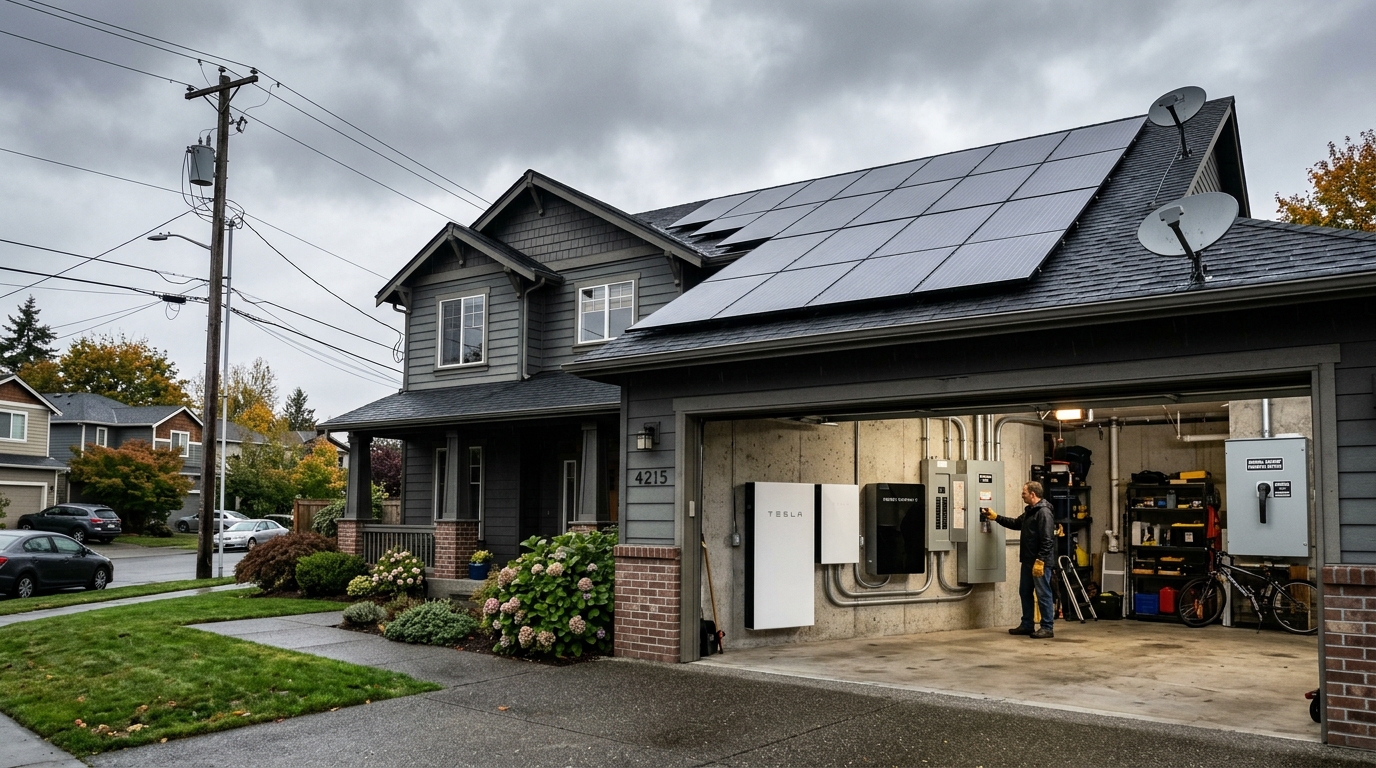
Key Takeaways
- Grid-tied with battery backup (hybrid) gives you net metering savings AND blackout protection — the best of both grid-tied and off-grid worlds.
- Hybrid inverters like the EG4 6000XP, Sol-Ark 15K, and Enphase IQ Battery handle grid-tie, battery charging, and backup switching in one unit.
- A critical loads panel isolates what you back up during outages. Most homes back up the fridge, lights, internet, and a few outlets — not the HVAC, dryer, or oven.
- You will need an electrician for the main panel work, utility interconnection, and final inspection. The DC side (panels, batteries, charge controller) is DIY-friendly. The AC side has code and permit requirements that demand a licensed professional.
- Total cost runs $1.50-2.50/watt installed vs. $0.80-1.20/watt for grid-tied without backup. The battery and hybrid inverter add $3,000-8,000 to a typical system.
- The federal ITC (30% tax credit) applies to batteries installed with solar — see our ITC guide for eligibility details.
How Hybrid Systems Differ from Pure Grid-Tied and Off-Grid
There are three different approaches to residential solar, and understanding the distinctions saves you from buying the wrong equipment.
Pure grid-tied (no battery): Panels feed a grid-tie inverter that synchronizes with the utility. Surplus power flows to the grid for net metering credits. When the grid goes down, your system shuts off completely — this is called anti-islanding, and it’s a safety requirement to protect line workers. Cost: $0.80-1.20/watt for the solar portion.
Pure off-grid: Your system is your only power source. Batteries are mandatory and must be sized for worst-case scenarios (multiple cloudy days in winter). No utility connection at all. Cost: $2.00-3.50/watt, heavily dependent on battery bank size.
Grid-tied with battery backup (hybrid): Your system connects to the grid for net metering but also includes a battery bank and a transfer mechanism. During normal operation, you export surplus and import when needed. During an outage, the system disconnects from the grid (to satisfy anti-islanding requirements) and powers your critical loads from batteries and solar. Cost: $1.50-2.50/watt.
I run a hybrid system on my house — panels, an EG4 6000XP inverter, and a LiFePO4 battery bank. During normal days, I use my own solar first, send surplus to the grid, and buy grid power overnight. During outages (we get several per year in Rhode Island), the batteries keep the fridge, freezer, internet, lights, and my home office running until power comes back. The longest outages have pushed the batteries below 30% state of charge before the grid returned. Tight, but the system did its job.
For an overview of all three system types and how to choose, our getting started guide covers the fundamentals.
Hybrid Inverters: The Brain of the System
A hybrid inverter combines three functions that would otherwise require separate equipment: grid-tie inverter, battery charger/inverter, and automatic transfer switch. It manages power flow between panels, batteries, grid, and your loads based on programmed priorities.
How They Work
During normal operation, a hybrid inverter follows a priority sequence:
- Solar power feeds your household loads first
- Excess solar charges the battery bank
- Once batteries are full, excess solar exports to the grid for net metering credits
- When solar can’t meet demand (evening/night), batteries discharge to cover the shortfall
- If batteries reach their minimum state of charge, the grid picks up the remaining load
During a grid outage:
- The inverter detects loss of grid voltage and opens its internal transfer switch (disconnecting from the grid)
- The inverter powers your critical loads panel from batteries and solar
- Solar continues charging batteries during daylight hours
- When grid power returns, the inverter reconnects after a stabilization delay (usually 5 minutes)
This all happens automatically. My EG4 switches to backup in under 20 milliseconds — fast enough that my computer doesn’t even blink. Some cheaper inverters take 50-100ms or longer, which can briefly interrupt sensitive equipment or cause a visible flicker.
Popular Hybrid Inverters
EG4 6000XP (6kW, 48V)
This is what I run, and I wrote a detailed review after a year of use. It’s a split-phase 120/240V inverter with two MPPT charge controllers built in, 6,000W continuous output, and a 12,000W surge rating. Street price is around $1,400-1,600.
The EG4 handles the vast majority of residential hybrid builds under 6kW. For a broader comparison of hybrid inverter options, see our best all-in-one solar inverters for 2026. It’s not perfect — the fan is audible under heavy load, and the configuration software has a learning curve — but at this price point, nothing else comes close on features. Two built-in MPPT inputs mean you don’t need a separate charge controller for systems up to about 6.5kW of panels.
Sol-Ark 15K (15kW, 48V)
The premium option for larger systems. 15kW continuous, 200A pass-through, generator input, and arguably the best software interface in the residential hybrid space. At $4,500-5,000, it costs three times the EG4, but it handles whole-home backup for many households without a critical loads subpanel.
I’ve seen Sol-Ark 15K installations with 10kW of panels and 30 kWh of batteries. The system can back up an entire panel including the heat pump. The Sol-Ark’s generator input also manages a propane backup generator automatically — when batteries drop below 20%, the generator starts and charges until they hit 80%.
Enphase IQ Battery + IQ8 Microinverters
A fundamentally different approach. Instead of a single hybrid inverter, Enphase uses microinverters on each panel (the IQ8 series can function without grid presence) paired with the IQ Battery for storage. The system is modular — add battery capacity in 5 kWh increments.
Enphase is the dominant player in professional solar installations, and their monitoring platform is excellent. The downside for DIYers: Enphase microinverters require an Enphase-certified installer for warranty coverage, and the per-watt cost is higher than string inverter solutions. If you’re hiring a professional installer anyway, Enphase is a strong choice. For true DIY builds, the EG4 or Sol-Ark route is more practical.
SolarEdge Energy Hub + Home Battery
Similar to Enphase in that it uses optimizers on each panel for module-level monitoring and rapid shutdown compliance. The Energy Hub inverter adds battery capability to SolarEdge’s already popular residential inverter line. Priced between EG4 and Sol-Ark. Strong monitoring platform. Like Enphase, the installation ecosystem assumes professional installers.
Inverter Sizing
Your hybrid inverter needs to handle your peak simultaneous load from the critical loads panel. A 6kW inverter can supply 6,000 watts continuously — that’s the fridge compressor starting (1,200W surge), plus the well pump (1,500W), plus lights and electronics (500W), with headroom to spare.
The key spec is surge rating. Motor-driven loads (fridge, pump, HVAC blower) draw 3-5x their running wattage for a fraction of a second at startup. A 6kW inverter with a 12kW surge handles most critical load scenarios. If you’re backing up a heat pump or central AC, you’ll need the Sol-Ark 15K or multiple inverters.
Use our Solar System Sizer to calculate your critical load requirements.
Net Metering: Getting Paid for Your Surplus
Net metering is the financial engine that makes grid-tied solar (with or without battery) economically compelling. When your panels produce more than you consume, the surplus flows to the grid and your meter runs backward (or your utility credits your account).
How It Works
Your utility installs a bidirectional meter that tracks both import and export. At the end of each billing cycle, you pay only for your net consumption. If you exported more than you imported, the excess typically rolls over as a credit to next month.
On a well-sized system, summer months produce far more than you use. It’s common to build up $100-200 in credits from June through September, then draw them down through the darker winter months. Many homeowners see their annual electric bill drop from $1,500-2,000/year to under $300/year — with the remainder being mostly fixed connection charges that net metering can’t offset.
State Variations
Net metering policies vary dramatically by state and utility, and they’re changing fast. The three main models:
Full retail net metering: Your exports are credited at the full retail rate (what you’d pay to buy that electricity). This is the most favorable for homeowners and exists in about 35 states as of early 2026, though several are phasing it out.
Reduced-rate net metering: Your exports are credited at a rate below retail — often the “avoided cost” or wholesale rate, which is typically 30-60% of retail. California’s NEM 3.0 (now in effect) is the highest-profile example. Under reduced-rate net metering, batteries become significantly more valuable because you’re better off storing surplus and using it yourself rather than exporting at a low rate.
No net metering / buy-all-sell-all: Some utilities and states offer no net metering at all, or use a buy-all-sell-all structure where your solar production is purchased separately at wholesale and your consumption is billed at retail. These markets strongly favor battery backup systems that maximize self-consumption.
Before you buy anything, check your utility’s specific net metering policy. Call them directly — don’t rely on forum posts from three years ago. Policies change, grandfathering clauses expire, and rate structures get revised.
How Batteries Change the Net Metering Equation
Without batteries, you export surplus during the day (often at midday when rates are lowest on time-of-use plans) and import at night (often at higher rates). With batteries, you store that midday surplus and use it during expensive evening peak hours.
On my utility’s time-of-use rates, I programmed my EG4 to charge batteries from solar during the day, discharge to cover my evening peak (4-9 PM at $0.18/kWh), and only pull from the grid overnight at off-peak rates ($0.08/kWh). This time-shifting saves roughly $30-40/month on top of the net metering credits.
The Critical Loads Panel
Here’s where hybrid systems get physically different from simple grid-tied installations. You need a way to separate the loads you want backed up during an outage from the loads you don’t.
What It Is
A critical loads panel (also called a backup subpanel or essential loads panel) is a secondary electrical panel fed by your hybrid inverter. During normal operation, it receives power from the grid through the inverter. During an outage, it receives power from batteries and solar only.
You physically move the circuits you want backed up from your main panel to this subpanel. Everything else stays on the main panel and goes dark during an outage.
What to Back Up
The goal is to keep the essentials running without oversizing your battery bank and inverter. Here’s how I prioritized mine:
Always back up:
- Refrigerator and freezer (food preservation — this is #1)
- Internet modem and router (communication, remote work)
- LED lighting circuits (safety)
- A few general-purpose outlets (phone charging, laptop)
Consider backing up:
- Well pump (if you’re on well water — no water without it)
- Garage door opener (getting your car out matters)
- Security system
- Sump pump (if you have a flooding risk)
- Gas furnace blower (the burner uses gas, but the blower is electric)
Usually leave on the main panel:
- Electric water heater (huge draw, 4,500W)
- Clothes dryer (5,000W+ — will drain your batteries fast)
- Electric oven/range (8,000W+ — way too large)
- Central AC (3,000-5,000W continuous — only back up with Sol-Ark 15K or larger)
- EV charger (2,000-11,500W — park at a charger during outages)
My critical loads panel has eight circuits: fridge, freezer, four lighting circuits, living room outlets, and home office outlets. Total peak draw is about 2,500W. My 6kW inverter handles it effortlessly, and my 14.3 kWh battery bank gives me roughly 24-30 hours of runtime on these loads alone (more with solar supplementing during the day).
Installation
This is the part where I strongly recommend hiring an electrician. Moving circuits between panels involves working in your main breaker panel with the utility service entrance — live conductors at 200A that can kill you instantly. The critical loads panel also needs to be properly sized, bonded, and labeled per NEC code.
I handled all the DC work myself — solar panels, wiring, battery bank, charge controller. When it came to the critical loads panel, transfer switch wiring, and main panel modifications, I hired a licensed electrician. Expect to pay $800-1,500 for this work depending on complexity and your area. Worth every penny for the peace of mind and the clean inspection result.
Transfer Switches and Anti-Islanding
Why Anti-Islanding Matters
When the grid goes down, utility line workers go out to fix it. They expect the lines to be dead. If your solar system is still energizing the grid (creating an “island” of power), those workers can be electrocuted.
Every grid-tied inverter — hybrid or otherwise — is required to detect grid loss and disconnect within 2 seconds. This is mandated by UL 1741 and IEEE 1547. Your hybrid inverter has this capability built in.
Automatic Transfer Switches (ATS)
Most hybrid inverters include an internal automatic transfer switch. When grid power drops, the ATS disconnects the critical loads panel from the grid and reconnects it to the inverter’s battery-backed output. When grid power returns and stabilizes, the ATS reconnects to the grid.
Some installations use an external transfer switch — either a manual one (you physically flip it during an outage) or an automatic one (electrically operated). External transfer switches are common with inverters that don’t have a built-in ATS, or in systems where the transfer needs to happen upstream of the main panel.
The EG4 6000XP has a built-in ATS with a transfer time under 20ms. The Sol-Ark 15K manages the same. For the Enphase system, the IQ System Controller handles transfer switching.
Permits, Inspections, and Where DIY Gets Complicated
Grid-tied solar with battery backup sits at the intersection of electrical work, utility policy, and local building codes. This is where pure DIY gets harder than off-grid builds.
What You’ll Need
Building permit: Almost every jurisdiction requires a building permit for grid-tied solar. The permit application typically includes a system design, electrical diagrams, structural calculations (for roof-mounted panels), and equipment spec sheets.
Electrical permit: Required for any work in or connected to your main electrical panel. In most jurisdictions, this must be pulled by a licensed electrician.
Utility interconnection agreement: Your utility needs to approve your system before you connect it to the grid. This process varies from a simple online form (some progressive utilities) to a months-long engineering review (some large utilities with high solar penetration). You’ll submit your system specs, and the utility will assess whether your local transformer and distribution lines can handle your export.
Inspection: After installation, a building inspector and possibly a utility inspector will verify the installation meets code. They check wire sizing, fusing, grounding, labeling, rapid shutdown compliance, and the critical loads panel setup.
The DIY Line
Here’s how I draw the line on what to DIY and what to hire out:
DIY-friendly:
- Solar panel mounting and wiring
- DC wiring from panels to inverter/charge controller
- Battery bank assembly and wiring (see our LiFePO4 battery guide)
- Charge controller installation and programming
- Monitoring system setup
Hire an electrician:
- Main panel modifications
- Critical loads subpanel installation and circuit migration
- AC wiring from inverter to panels
- Grounding electrode conductor
- Utility meter and interconnection
- Rapid shutdown system installation
- Final connections and energization
Handle the paperwork yourself (or with help):
- Permit applications (many jurisdictions let homeowners pull their own permits)
- Utility interconnection agreement
- ITC tax credit documentation (see our federal solar tax credit guide)
This split approach saved me about $4,000 compared to a full professional installation while keeping the dangerous and code-sensitive work in qualified hands.
Rapid Shutdown
NEC 2020 (and later editions adopted by most jurisdictions) requires rapid shutdown — a way to de-energize rooftop conductors within 30 seconds to protect firefighters. For string inverter systems, this typically means module-level power electronics (MLPEs) like Tigo optimizers or SolarEdge power optimizers on each panel, plus a rapid shutdown initiator near the inverter.
The EG4 6000XP doesn’t include rapid shutdown — you’ll need to add Tigo TS4-A-O optimizers (about $35/panel) or equivalent. The Sol-Ark works with SolarEdge optimizers. Enphase microinverters inherently satisfy rapid shutdown because each microinverter is module-level.
Budget $200-400 for rapid shutdown compliance on a typical residential system.
Cost Breakdown: Grid-Tied Only vs. Hybrid
Here’s a realistic cost comparison for a 5kW residential system in 2026, before the 30% ITC tax credit:
| Component | Grid-Tied Only | Grid-Tied + Battery Backup |
|---|---|---|
| Solar panels (10x 500W) | $1,500 | $1,500 |
| Inverter | $800 (grid-tie only) | $1,500 (hybrid — EG4 6000XP) |
| Battery bank | — | $2,500 (14 kWh LiFePO4) |
| Racking/mounting | $600 | $600 |
| Wire, fuses, disconnects | $300 | $500 |
| Rapid shutdown | $350 | $350 |
| Critical loads panel | — | $400 |
| Electrician (AC work) | $800 | $1,200 |
| Permits and fees | $300 | $400 |
| Total before ITC | $4,650 | $8,950 |
| After 30% ITC | $3,255 | $6,265 |
The battery backup adds about $4,300 to the system cost ($3,000 after ITC). Whether that’s worth it depends on how much you value backup power and how often you lose grid power.
For my area with 4-5 outages per year — including occasional multi-day events — it was an easy yes. If you lose power once every three years for two hours, the math is harder to justify on pure economics. But a lot of people are adding batteries for peace of mind as much as for ROI.
Build your own system budget with our Cost Estimator.
Programming Your Hybrid System
Once the physical installation is complete and inspected, you need to program the inverter’s operating mode. Most hybrid inverters offer several modes:
Self-Use Priority (Most Common)
Solar charges batteries first, then powers loads, then exports surplus. At night, batteries discharge before grid power is used. This maximizes self-consumption and minimizes grid purchases.
I run self-use mode with a minimum battery reserve of 20%. The system never discharges below 20% during normal operation, saving that reserve for outage backup. During an actual outage, it’ll discharge to 5%.
Time-of-Use Optimization
If your utility has time-of-use rates, you can program the inverter to charge batteries during cheap off-peak hours (from solar or grid) and discharge during expensive peak hours. This is especially valuable in California and other states with significant peak/off-peak rate differences.
Backup-Only Mode
Batteries stay fully charged and only discharge during grid outages. Solar exports everything to the grid for net metering. This mode makes sense if you have full retail net metering and no time-of-use rates — you get maximum export credit while maintaining backup capability.
Grid-First Mode
Grid power handles all loads, solar charges batteries only, and batteries are reserved for backup. Rarely used in residential, but some commercial installations use this configuration.
What to Expect from a Hybrid System
Here are realistic numbers from a 5kW hybrid system in New England:
- Annual solar production: 5,500-7,000 kWh depending on panel orientation and shading
- Self-consumption: 55-65% is typical
- Electric bill reduction: Many homeowners go from $1,500-2,000/year to under $300/year
- Outages survived: A 10-15 kWh battery bank handles most residential outages comfortably
- System issues: Occasional firmware updates, but modern hybrid inverters are largely set-and-forget
A well-designed system pays for itself in about 4-6 years after the ITC credit. After that, it’s effectively free electricity with backup protection. The batteries are rated for 6,000+ cycles at 80% depth of discharge — that’s 16+ years of daily cycling. The panels carry a 25-year warranty.
Common Questions
Can I add batteries to an existing grid-tied system? Sometimes. If you have a string inverter (SolarEdge, Fronius), you can add an AC-coupled battery system like the Enphase IQ Battery or a DC-coupled solution by adding a hybrid inverter. If you have microinverters (Enphase IQ7 or IQ8), AC coupling with the IQ Battery is the cleanest path. This usually costs more and is less efficient than building hybrid from the start, so if you’re considering batteries down the road, spec a hybrid inverter from day one.
Do I need a generator too? For most residential hybrid systems with 10-15 kWh of battery storage, no. Solar recharges the batteries each day during extended outages. A generator becomes relevant if you need to back up large loads (central AC, well pump running frequently) or if your area experiences week-long outages in winter when solar production is minimal. I don’t have a generator and haven’t needed one yet.
What about LFP vs. lead-acid for hybrid backup? LiFePO4, no question. Lead-acid’s 50% usable depth of discharge means you need twice the capacity. The weight difference matters in a home (lead-acid batteries for 14 kWh of usable storage would weigh over 800 lbs). And lead-acid needs equalization charging, which hybrid inverters handle clumsily. Our best LiFePO4 batteries roundup covers the top options for home storage.
Will my utility let me interconnect a DIY system? This varies enormously. Some utilities are DIY-friendly (you pull permits, you install, they inspect). Others require a licensed contractor for everything. Call your utility’s interconnection department before buying equipment. Ask specifically: “Can a homeowner self-install a grid-tied solar system with battery backup, and what documentation do you require?”
Grid-tied solar with battery backup is the most flexible residential energy system you can build. It’s also the most complex, the most regulated, and the most expensive tier of DIY solar. But daily bill reduction, net metering credits, and blackout protection together make it the right choice for a growing number of homeowners. Do the math, understand your local permit requirements, and hire an electrician for the parts that demand one. Hybrid systems are reliable, well-documented, and — with the 30% ITC — affordable.
Frequently Asked Questions
What is a hybrid solar system?
A hybrid solar system connects to the utility grid for net metering while also including a battery bank for backup power. During normal operation, you export surplus solar to the grid. During outages, the system disconnects from the grid and powers critical loads from batteries and solar.
How much does a grid-tied solar system with battery backup cost?
A typical 5kW hybrid system costs $8,950 before the 30% federal tax credit, or $6,265 after. That is about $4,300 more than grid-tied without battery. The battery and hybrid inverter account for most of the added cost.
Do I need an electrician for a hybrid solar system?
Yes, for the AC side. Main panel modifications, critical loads subpanel installation, utility interconnection, and rapid shutdown wiring should be done by a licensed electrician. You can handle the DC wiring, panel mounting, and battery bank assembly yourself.
What is a critical loads panel?
A critical loads panel (also called a backup subpanel) is a secondary electrical panel fed by your hybrid inverter. You move essential circuits (fridge, lights, internet, key outlets) to this panel. During outages, only these circuits receive backup power, which keeps your battery bank and inverter properly sized.
Can I add batteries to an existing grid-tied solar system?
Yes, but it is easier and more efficient to plan for batteries from the start. You can AC-couple a battery system like the Enphase IQ Battery, or add a hybrid inverter. Adding batteries later typically costs more and is less efficient than building hybrid from day one.
Anthony
Solar homeowner, EV driver, and DIY builder. Using solar to power a large part of my home.
Get build guides in your inbox
Weekly solar builds, product tests, and technical deep-dives.
Subscribe Free