How to Size and Install an MPPT Charge Controller
Key Takeaways
- MPPT controllers harvest 15-30% more energy than PWM controllers by converting excess panel voltage into additional charging current.
- Size your controller by checking three numbers: panel array Voc (must stay under controller max input voltage), total panel wattage (must not exceed controller rating), and battery voltage.
- Always connect batteries first, then panels. Disconnect in reverse order. Getting this wrong can destroy your controller instantly.
- Fuse the battery side. A charge controller without a battery-side fuse is a fire waiting to happen.
- LiFePO4 and lead-acid need different voltage settings. Wrong absorption/float voltages will damage your batteries or leave them permanently undercharged.
What MPPT Actually Does (and Why It Matters)
Your solar panels produce a voltage that changes throughout the day based on sunlight intensity, temperature, and shading. That voltage is almost never the ideal voltage for charging your batteries. This mismatch is where energy gets wasted — and where MPPT earns its keep.
MPPT stands for Maximum Power Point Tracking. The controller continuously samples your panel array’s output, finds the voltage/current combination that produces maximum power (the “maximum power point”), and then converts that into the voltage and current your batteries need.
Think of it like a DC-DC converter that’s constantly adjusting its ratio. If your panels are producing 75V at 8A (600W), and your 24V battery bank needs charging at 29V, an MPPT controller converts that to roughly 29V at 19.5A — same 600W, minus about 2-5% conversion loss. A PWM controller in the same scenario would just clamp the panel voltage down to battery voltage and throw away the excess. You’d get 29V at 8A — only 232W out of 600W available. That’s an enormous waste.
I’ve measured the difference in a side-by-side test. Two identical 200W panels, same orientation and tilt, one feeding a Victron SmartSolar 100/30 MPPT and the other feeding a cheap PWM controller. Over a full week in March, the MPPT panel delivered 27% more energy to the battery. On partly cloudy days, the gap was even wider — over 30%.
When PWM Still Makes Sense
PWM controllers aren’t completely useless. They work acceptably when your panel voltage closely matches your battery voltage — for example, a single “12V nominal” panel (Vmp around 18V) charging a 12V battery. In that scenario, the voltage mismatch is small, so the PWM penalty is minor.
I still use a $15 PWM controller on a single 100W panel that runs a small circulation pump on my rainwater system. It works fine because the panel and battery voltages are well-matched and I don’t care about squeezing every last watt. But for any system where you’re spending real money on panels, MPPT pays for itself quickly.
How to Size Your MPPT Charge Controller
This is where most beginners make mistakes. A charge controller has three critical ratings you need to match against your panel array and battery bank.
Step 1: Check Maximum Input Voltage
Every MPPT controller has a maximum input voltage — typically 100V, 150V, or 250V for residential controllers. Your panel array’s open-circuit voltage (Voc) must never exceed this rating, even in the coldest temperatures your location experiences.
Why cold temperatures? Solar panel voltage increases as temperature drops. A panel rated at 40V Voc at standard test conditions (25°C / 77°F) might produce 46V at -10°C (14°F). If you’ve strung three of those panels in series, you’re looking at 138V on a cold morning — which would fry a 100V-rated controller.
Here’s how to calculate cold-temperature Voc:
- Find your panel’s Voc at STC (on the datasheet)
- Find the temperature coefficient of Voc (usually around -0.27% to -0.35% per °C)
- Determine the coldest temperature your panels will experience
- Calculate: Adjusted Voc = Voc × [1 + (temp coefficient × (cold temp - 25°C))]
Example: Three panels in series, each with 41.5V Voc and -0.29%/°C coefficient, installed where it hits -15°C in winter.
- Temperature delta: -15 - 25 = -40°C
- Voltage increase: -0.29% × -40 = +11.6%
- Adjusted Voc per panel: 41.5 × 1.116 = 46.3V
- Three panels in series: 46.3 × 3 = 138.9V
That array needs a 150V controller, not a 100V unit. I’ve seen this exact miscalculation happen — a 100V controller paired with a 3-panel string that hit 112V on a January morning. The controller went into overvoltage protection and shut down. It was lucky the unit protected itself instead of just dying.
Use our Solar System Sizer to run these calculations automatically.
Step 2: Match Controller Wattage to Array Size
Charge controllers are rated by their maximum output current at a given battery voltage. A “Victron 100/50” means 100V max input and 50A max output. The wattage it can handle depends on your battery voltage:
- At 12V: 50A × 14.4V (absorption) ≈ 720W
- At 24V: 50A × 28.8V ≈ 1,440W
- At 48V: 50A × 57.6V ≈ 2,880W
This is why higher battery voltages let you use a smaller (cheaper) controller for the same panel array. A 2,000W array on a 12V system needs a massive controller. The same array on a 48V system needs a modest one.
My rule of thumb: Size the controller for at least 10% more wattage than your current panel array. This gives you headroom for panel overproduction on cold, clear days (panels can exceed their rated wattage when it’s cold and sunny) and room to add a panel later.
Step 3: Verify Battery Voltage Compatibility
Most modern MPPT controllers auto-detect 12V/24V systems, and many support 48V as well. But verify this before buying — especially for 48V systems. Some budget controllers top out at 24V.
If you’re building a LiFePO4 battery bank (and you should be — see our LiFePO4 battery bank guide for why), make sure the controller has a LiFePO4 charging profile or user-programmable voltage settings.
Popular MPPT Controllers Worth Considering
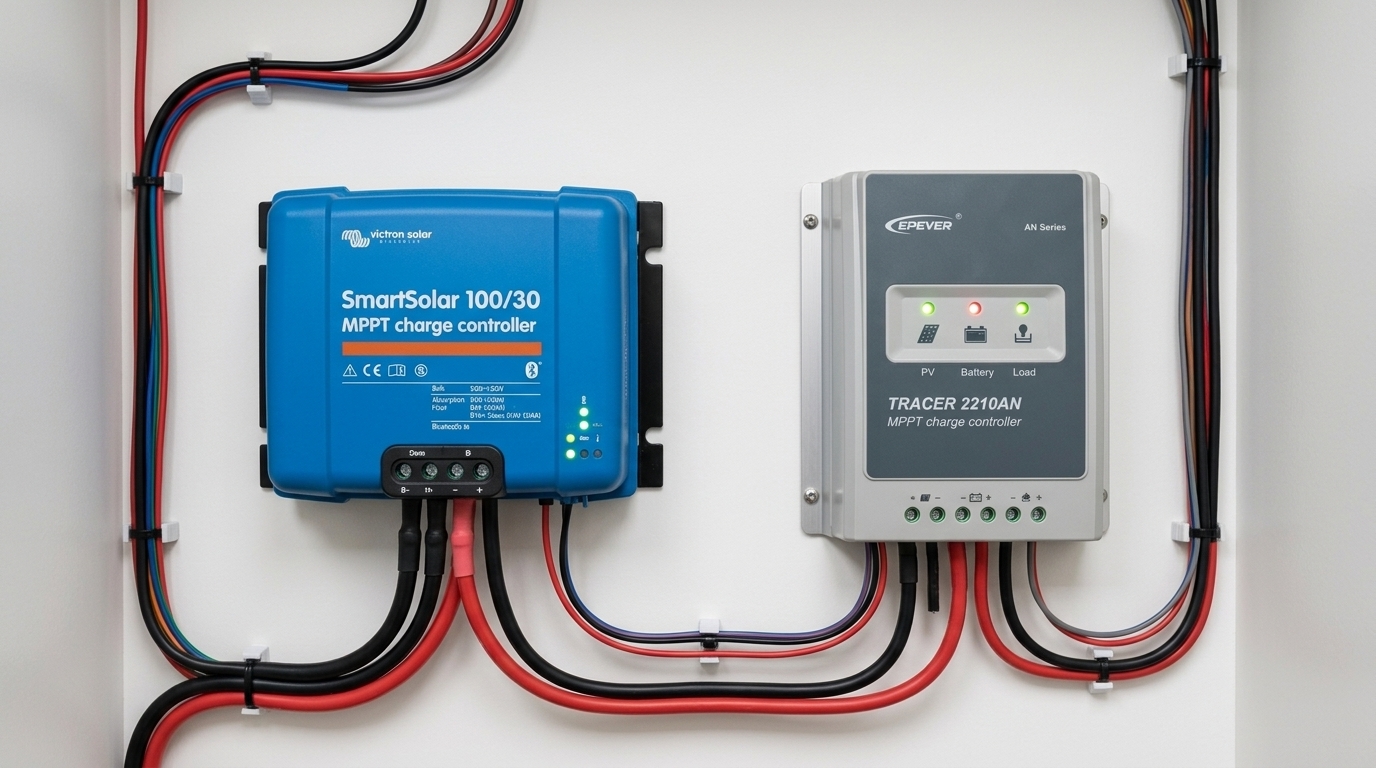
I’ve used or directly tested the following controllers. Here’s my take on each. For a deeper head-to-head with 30 days of measured harvest data, see our best MPPT charge controllers for 2026 roundup.
Victron SmartSolar Series (100/30, 150/35, 250/60, etc.)
Price: $180 - $550 depending on size
The benchmark for DIY solar. Victron’s build quality is excellent, their Bluetooth app is genuinely useful for monitoring and configuration, and their VE.Direct protocol lets you integrate with monitoring systems like Cerbo GX. Every setting is user-configurable, which matters when you’re running LiFePO4 batteries that need specific voltage targets.
I’ve run Victron controllers on multiple systems and they’ve been rock-solid.
Downside: Price. You pay a 30-40% premium over comparable Chinese controllers. For me, the reliability and support justify it. For a tight budget, keep reading.
EPEver Tracer Series (3210AN, 4210AN, 6415AN)
Price: $80 - $250
The best budget MPPT controllers I’ve tested. The Tracer AN series offers genuine MPPT tracking (not the fake “MPPT” some cheap controllers claim), user-programmable charge voltages, and a decent remote monitoring display. Build quality is a step below Victron but perfectly adequate for most builds.
I’ve tested an EPEver 4210AN (40A, 100V input) and it performs well — within 2-3% of the Victron in side-by-side testing.
Downside: The software for PC configuration is clunky and Windows-only. Documentation is mediocre. You’ll spend more time on forums figuring out settings.
Renogy Rover Series (20A, 30A, 40A)
Price: $100 - $200
Widely available, decent build quality, good documentation for beginners. Renogy sells complete kits that include the Rover, which makes them a convenient option if you’re buying an all-in-one setup.
Downside: In my testing, the Rover’s MPPT tracking was slightly less efficient than the EPEver Tracer — about 3-5% less energy harvested over a week. The Rover also has a lower maximum input voltage (100V), which limits string sizing.
Sizing Cheat Sheet
| System Size | Battery Voltage | Recommended Controller | Approx. Cost |
|---|---|---|---|
| 200-400W | 12V | EPEver 3210AN (30A/100V) | $80-100 |
| 400-800W | 12V or 24V | Victron 100/30 or EPEver 4210AN | $130-200 |
| 800-1500W | 24V or 48V | Victron 150/35 | $250-300 |
| 1500-3000W | 48V | Victron 250/60 or 250/100 | $400-650 |
| 3000W+ | 48V | Multiple controllers in parallel | $600+ |
For help figuring out the right wire sizes between your panels, controller, and battery bank, use our Wire Gauge Calculator or check the solar wire gauge reference chart.
Installation: Step by Step
This is where attention to detail matters. A wiring mistake with a charge controller can destroy the unit, damage your batteries, or start a fire. Follow this sequence exactly.
Wiring Order: Batteries First, Always
Connect in this order:
- Battery cables to the controller (positive and negative)
- Panel cables to the controller (positive and negative)
Disconnect in reverse order:
- Panel cables from the controller
- Battery cables from the controller
The charge controller needs to sense battery voltage before it sees panel voltage. If you connect panels first with no battery attached, the controller sees unregulated panel voltage on its output terminals with no load to absorb it. I’ve seen this kill controllers instantly — a puff of smoke and the unit is dead.
Fusing: Non-Negotiable
You need fuses (or breakers) on both sides of the controller:
Battery side: Install a fuse between the battery bank and the charge controller. Size it to 125% of the controller’s maximum output current. For a 50A controller, use a 60A or 70A fuse. This protects against a short circuit in the controller or wiring.
Panel side: Install a fuse or breaker between the panel array and the controller. Size it above the array’s maximum short-circuit current (Isc). For two parallel strings of panels, add the Isc values together.
I use Blue Sea Systems fuse blocks with ANL fuses for the battery side and Midnite Solar MNPV combiner boxes with fuses for the panel side. Both are rated for DC circuits — never use AC-rated breakers on DC circuits. DC arcs don’t self-extinguish at zero-crossing like AC arcs do, so DC-rated protection devices are designed to physically extinguish the arc.
Wire Sizing
Undersized wire creates resistance, which creates heat, which creates fire risk. It also wastes energy as voltage drop.
For the battery-to-controller run, keep voltage drop under 2%. For the panel-to-controller run, keep it under 3%. The Wire Gauge Calculator on this site accounts for distance, current, and voltage to give you the right gauge.
As a quick reference: a 50A controller on a 48V system with a 10-foot battery run needs at minimum 6 AWG copper wire. The same 50A on a 12V system needs 2 AWG — four times the copper cross-section. This is another reason higher battery voltages save money.
Grounding
Ground your charge controller’s grounding terminal to your system ground bus. If your panels have metal frames (most do), ground those frames too. For a detailed walkthrough of grounding requirements, see the getting started guide — the grounding section covers both equipment grounding and grounding electrode conductors.
Programming Your Charge Controller
Once everything is wired and powered up, you need to set the charging parameters. Getting this right is the difference between batteries that last a decade and batteries you replace in two years.
LiFePO4 Settings (Most Common in 2026)
LiFePO4 batteries want specific, flat voltage targets with no equalization. Here are the standard settings for a 48V (16S) LiFePO4 bank:
| Parameter | Setting | Notes |
|---|---|---|
| Absorption voltage | 56.0 - 57.6V | Check your BMS specs; 3.50-3.60V per cell |
| Float voltage | 53.6V | 3.35V per cell; some setups disable float entirely |
| Equalization | Disabled | Never equalize LiFePO4 — it damages cells |
| Absorption time | 15-30 minutes | LiFePO4 doesn’t need long absorption; it charges efficiently |
| Low-temperature cutoff | 0°C / 32°F | LiFePO4 cannot be charged below freezing without damage |
| Tail current | 2-5A | End absorption when current drops to this level |
For 12V systems (4S), divide all voltages by 4. For 24V (8S), divide by 2.
I set my absorption voltage to 56.8V (3.55V/cell) based on my BMS’s recommended range. My float sits at 53.6V (3.35V/cell). With these settings, LiFePO4 banks cycle daily with minimal capacity loss over time.
Lead-Acid Settings (AGM/Flooded)
If you’re running lead-acid batteries (maybe on a budget build or a system that already has them), the settings differ significantly:
| Parameter | 48V AGM | 48V Flooded |
|---|---|---|
| Absorption voltage | 57.6V | 59.2V |
| Float voltage | 54.0V | 52.8V |
| Equalization | 60.0V (monthly) | 62.4V (monthly) |
| Absorption time | 2-4 hours | 2-4 hours |
Lead-acid batteries need longer absorption times and periodic equalization charges to prevent sulfation. They’re also less efficient — you’ll lose 15-20% of your solar harvest to heat during charging. This is one of many reasons I recommend LiFePO4 for new builds. Our LiFePO4 battery guide covers the full cost comparison.
Temperature Compensation
If your controller has a temperature sensor (most good ones include one), install it directly on the battery bank. Temperature compensation adjusts charge voltages based on battery temperature — important for lead-acid, less critical for LiFePO4 but still good practice.
Mount the sensor on the side of a battery cell, midway up, secured with thermal adhesive or the included mounting clip. Don’t just leave it dangling in the air near the batteries — it needs to read actual cell temperature.
Common Mistakes and How to Avoid Them
I’ve made some of these mistakes myself. Learn from my expensive lessons.
Mistake 1: Undersizing the Controller
A 1,000W panel array on a controller rated for 800W won’t harvest the full potential of your panels. The controller will current-limit, capping your output. You won’t damage anything, but you’ll permanently leave energy on the table.
Fix: Size the controller for your current array plus at least one additional panel you might add later. Use our Solar System Sizer to plan for future expansion.
Mistake 2: Exceeding Maximum Input Voltage
This one will kill your controller. I see it on solar forums every week — someone adds a third panel in series without recalculating cold-weather Voc, and the controller dies on the first cold morning.
Fix: Always calculate Voc at the coldest temperature your location will experience. Keep a 10% margin below the controller’s max input voltage. If you’re close to the limit, wire panels in parallel instead of series to keep voltage lower (at the cost of higher current and thicker wires). Our panel wiring guide covers the series vs. parallel tradeoffs in detail.
Mistake 3: No Fuse on the Battery Side
A battery bank can deliver hundreds or thousands of amps into a short circuit. Without a fuse between your batteries and charge controller, a wiring fault or controller failure can melt wires, start fires, or cause an explosion.
Fix: Always fuse the battery side. Use a DC-rated fuse or breaker sized to 125% of the controller’s rated output current.
Mistake 4: Wrong Charge Settings for Your Battery Chemistry
I once helped a friend troubleshoot a system where his “new” LiFePO4 batteries were only reaching 80% charge. The charge controller was set to the default lead-acid profile — absorption voltage was too low for LiFePO4, and the controller was going to float prematurely.
Fix: Always verify your charge profile matches your battery chemistry. When in doubt, consult your battery manufacturer’s recommended charge voltages and program them manually.
Mistake 5: Long Wire Runs with Thin Wire
Voltage drop over long wire runs reduces charging efficiency and can cause the controller to malfunction. I’ve seen systems where 15% of the solar harvest was being lost as heat in undersized cables between the panels and controller.
Fix: Use our Wire Gauge Calculator and keep voltage drop under 3% on the panel side. If the calculator says you need impractically thick wire, move the controller closer to the panels (or move the panels closer to the controller).
Monitoring and Maintenance
Once your controller is installed and programmed, monitoring is straightforward.
What to Watch
- Daily harvest (kWh): Track this over time. A sudden drop indicates a problem — shading, dirty panels, a wiring fault, or a failing panel.
- Peak power: Should be close to your array’s rated wattage on clear days. If your 1,000W array never exceeds 700W at solar noon, something is wrong. Check our low output troubleshooting guide for diagnostic steps.
- Battery voltage at end of absorption: Should hit your target voltage consistently. If it doesn’t, the controller might be current-limiting (undersized) or your batteries might have a problem.
- Controller temperature: Most controllers derate (reduce output) when they get too hot. If yours is derating regularly, improve ventilation or consider a larger controller.
Maintenance
MPPT controllers are essentially solid-state electronics with no moving parts. Maintenance is minimal:
- Clean dust from heat sinks every 6-12 months (more often in dusty environments)
- Check wire connections annually — torque them to spec, look for discoloration that indicates overheating
- Update firmware if the manufacturer releases updates (Victron does this regularly through their app)
- Inspect fuses for corrosion, especially in humid environments
MPPT controllers typically run for years with nothing more than an annual dust-off and connection check.
Putting It All Together
Here’s a real-world example to tie everything together. Say you’re building a system with four 450W panels and a 48V LiFePO4 battery bank.
Panel specs: Voc 41.5V, Isc 13.8A, Vmp 34.5V, Imp 13.0A
Configuration: Two strings of two panels in series, strings wired in parallel.
- String Voc: 41.5V × 2 = 83V
- Cold-weather Voc (at -10°C, -0.29%/°C coeff): 83V × 1.10 = 91.3V → needs 100V+ controller
- Total Isc: 13.8A × 2 strings = 27.6A
- Total array power: 4 × 450W = 1,800W
Controller selection: A Victron 100/50 (100V input, 50A output) handles this perfectly. At 48V, it supports up to 2,880W, so there’s room to add panels later.
Fusing: 60A DC fuse on the battery side (50A × 1.25 = 62.5A, round to 60A). 20A DC fuses per string on the panel side (Isc 13.8A × 1.25 = 17.25A, round to 20A).
Wire sizing: For a 15-foot run from panels to controller at 27.6A and ~70V, 10 AWG is sufficient. For a 6-foot battery run at up to 50A and 48V, 6 AWG works with plenty of margin. Verify with the Wire Gauge Calculator.
Programming: Absorption 56.8V, Float 53.6V, Equalization disabled, Absorption time 20 minutes, Low temp cutoff 0°C.
Use the Cost Estimator to budget the full system including the controller, fuses, wire, and breakers.
That’s it. A properly sized and installed MPPT charge controller is one of those components that just works once you set it up correctly. Take the time to do the math, buy the right fuses, follow the wiring order, and program it for your battery chemistry. Your future self will thank you when the system is quietly harvesting energy without any drama.
Frequently Asked Questions
What is the difference between MPPT and PWM charge controllers?
MPPT controllers convert excess panel voltage into additional charging current, harvesting 15-30% more energy than PWM. PWM simply clamps panel voltage to battery voltage, wasting the difference as heat. MPPT is worth the extra cost for any system over 400W.
How do I size an MPPT charge controller?
Check three numbers: your panel array's cold-weather Voc must stay under the controller's max input voltage, your total panel wattage must not exceed the controller's power rating at your battery voltage, and the controller must support your battery voltage (12V, 24V, or 48V).
Should I connect batteries or panels first to a charge controller?
Always connect batteries first, then panels. Disconnect in reverse order (panels first, then batteries). Connecting panels first without a battery can expose the controller to unregulated voltage and destroy it instantly.
What charge voltage should I set for LiFePO4 batteries?
For a 48V (16S) LiFePO4 bank, set absorption voltage to 56.0-57.6V (3.50-3.60V per cell), float to 53.6V (3.35V per cell), and disable equalization entirely. Never equalize LiFePO4 — it damages cells.
Why does my MPPT controller not reach full panel wattage?
Panels rarely produce their rated wattage in real conditions. Heat, dust, wiring losses, and non-optimal angles reduce output by 15-25%. If your controller consistently reaches 75-85% of nameplate on clear days at noon, it is working correctly.
Anthony
Solar homeowner, EV driver, and DIY builder. Using solar to power a large part of my home.
Get build guides in your inbox
Weekly solar builds, product tests, and technical deep-dives.
Subscribe Free