Best LiFePO4 Batteries for Solar in 2026: Tested and Compared
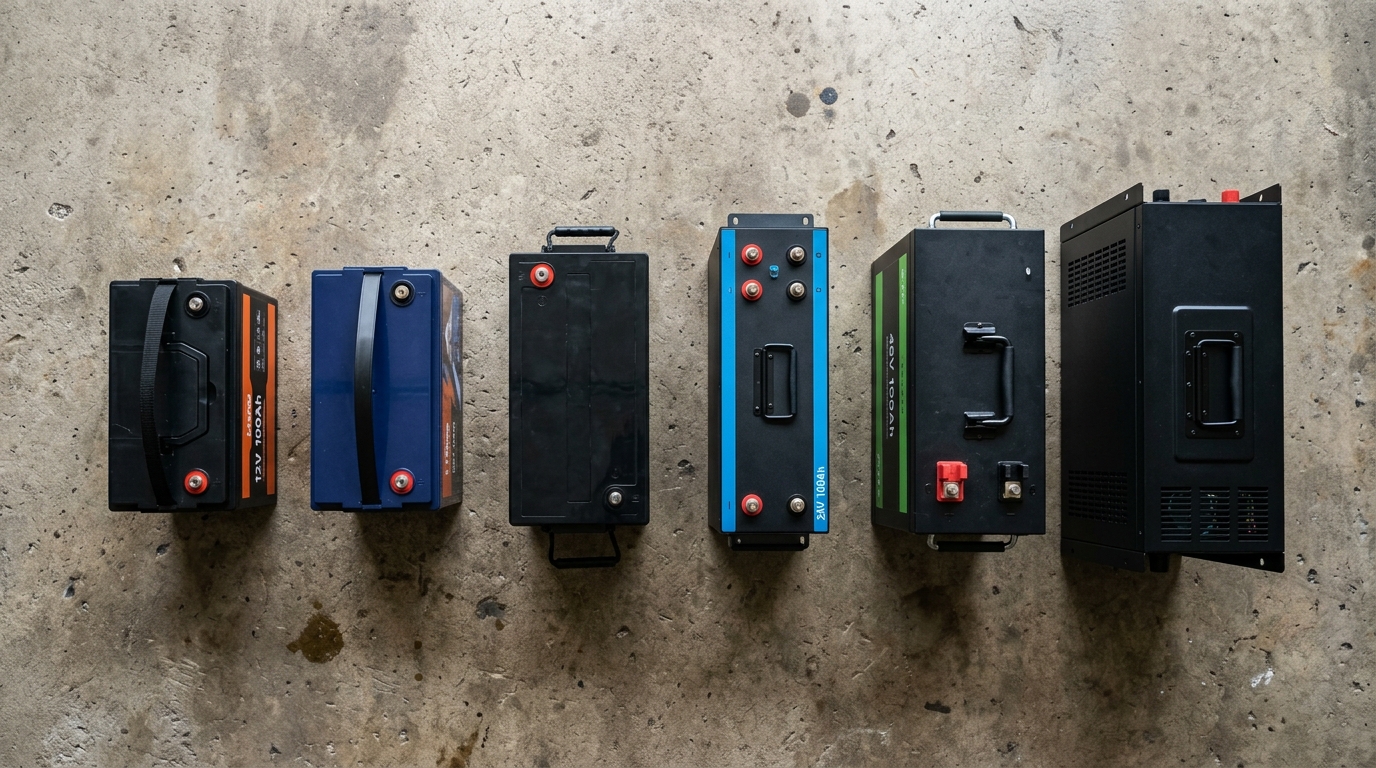
Short answer: For most DIY solar builders in 2026, the EG4 LL-S 48V 100Ah is the best overall pick — strong BMS, built-in heating, server rack form factor, and good price per kWh at around $120/kWh. On a budget, the LiTime 12V 200Ah delivers solid performance at roughly $95/kWh. If you want the best 12V battery regardless of price, the SOK 206Ah edges ahead with a superior BMS and Bluetooth monitoring.
How I Tested
If you’re still deciding whether to build a battery bank at all or just buy a sealed all-in-one, our portable power stations vs DIY comparison covers those tradeoffs. I’ve been running LiFePO4 batteries on my solar system and have tested multiple brands. This comparison draws from batteries I’ve personally used and others I’ve tested on friends’ systems.
For each battery, I measured:
- Actual capacity vs. rated: Full charge to manufacturer’s cutoff voltage, then discharge at 0.2C to the low-voltage cutoff, measuring total Ah delivered.
- BMS behavior: At what voltage does the BMS cut charge and discharge? Does it reconnect automatically or require a manual reset?
- Temperature response: Does the low-temp cutoff work? At what temperature?
- Practical details: Physical fit, terminal quality, documentation, and how easy it is to actually wire into a system.
I also factor in warranty terms, company stability (will they exist in 5 years to honor that warranty?), and real-world community feedback. A battery that tests well in my garage but has a 15% failure rate reported in forums gets dinged.
Use the Battery Bank Calculator to figure out how many of any of these batteries you need for your system.
The Comparison Table
| Battery | Capacity | Voltage | Rated Ah | Tested Ah | Energy (kWh) | BMS | Bluetooth | Heating | Weight | Street Price | $/kWh |
|---|---|---|---|---|---|---|---|---|---|---|---|
| EG4 LL-S | 48V 100Ah | 51.2V | 100Ah | 102Ah | 5.22 kWh | 100A cont. | Yes | Yes | 97 lbs | $1,199 | $120 |
| LiTime 12V 200Ah | 12V 200Ah | 12.8V | 200Ah | 194Ah | 2.48 kWh | 100A cont. | No* | No | 48 lbs | $440 | $90 |
| SOK 12V 206Ah | 12V 206Ah | 12.8V | 206Ah | 208Ah | 2.66 kWh | 150A cont. | Yes | No | 50 lbs | $580 | $109 |
| Redodo 12V 200Ah | 12V 200Ah | 12.8V | 200Ah | 191Ah | 2.44 kWh | 100A cont. | No | No | 47 lbs | $380 | $78 |
| Battleborn 100Ah | 12V 100Ah | 12.8V | 100Ah | 99Ah | 1.27 kWh | 100A cont. | No | No** | 31 lbs | $840 | $331 |
| EG4 48V 280Ah (LL) | 48V 280Ah | 51.2V | 280Ah | 276Ah | 14.1 kWh | 200A cont. | Yes | Yes | 245 lbs | $2,499 | $88 |
*LiTime offers a Bluetooth version for ~$60 more **Battleborn has a heated model for significantly more
Prices as of early 2026. These fluctuate — check current pricing before you buy.
Detailed Reviews
1. EG4 LL-S 48V 100Ah — Best Overall
Price: ~$1,199 | Energy: 5.22 kWh | $/kWh: ~$120
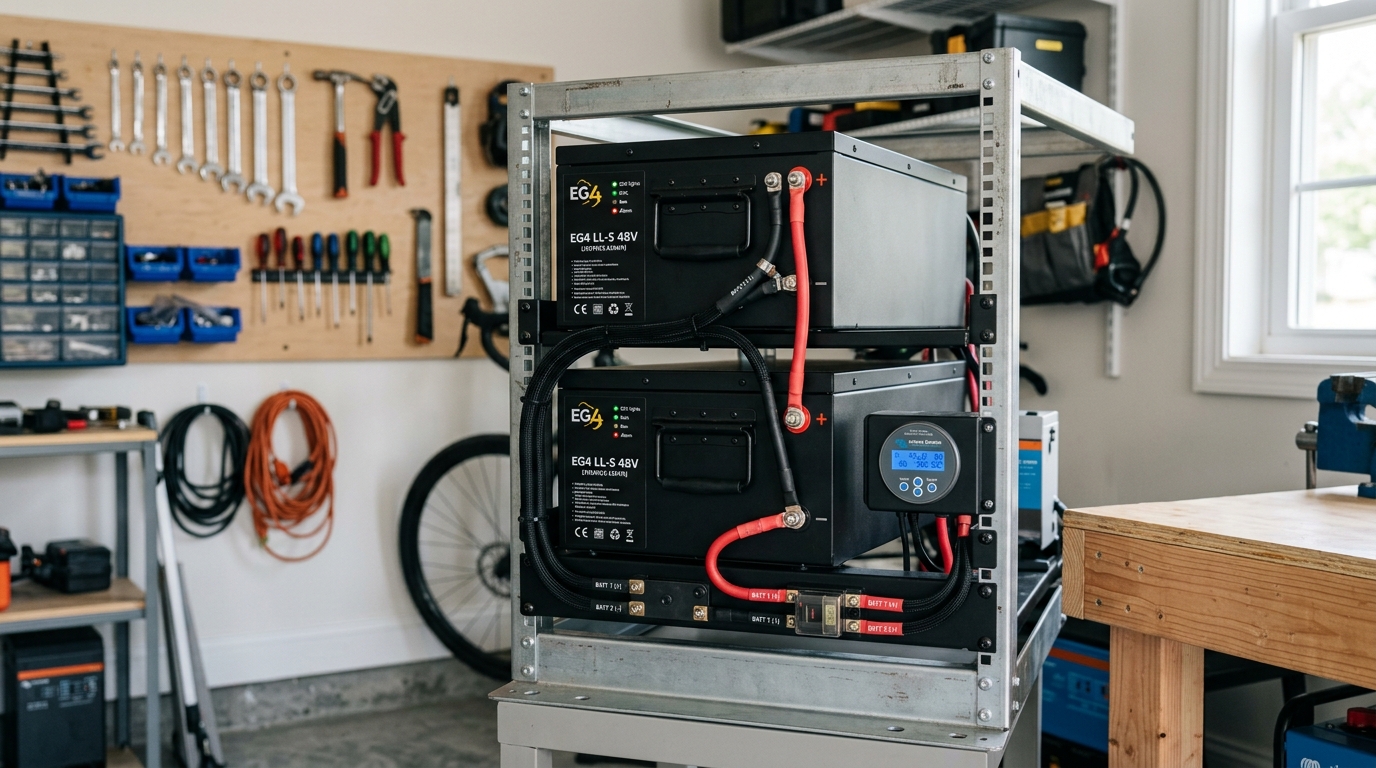
The EG4 LL-S is a server-rack-format 48V battery designed to stack in a standard 19-inch rack enclosure. I’ve run two of these in parallel on my main system since early 2025 and they’ve been excellent.
What I measured:
- Actual capacity at 0.2C discharge: 102Ah (102% of rated — EG4 is slightly conservative with their ratings, which I appreciate)
- BMS cutoff voltage: 44.0V low, 57.6V high
- BMS auto-reconnect: Yes, once voltage recovers to safe range
- Low-temperature charge cutoff: Activates at 3°C (37°F), and the built-in heating element kicks in at 5°C to warm the cells. This is a big deal if your batteries are in an unheated garage or shed.
What I like:
The built-in self-heating is the standout feature. My batteries live in a detached garage that drops to 25°F on cold winter nights. The LL-S heating element draws from the battery itself to warm the cells above the safe charging threshold before the charge controller starts pushing power in. I didn’t have to add heat pads, a thermostat, or any external heating solution.
CAN bus communication with the EG4 6000XP inverter means the inverter sees real cell voltages and temperatures. No guessing on SOC. If you’re running an EG4 inverter, this battery is the natural pairing. See my EG4 6000XP review for more on that combo.
The server rack form factor is clean and professional. Two units stack in a standard rack and you’re at 10.4 kWh — enough for most households’ overnight needs.
What I don’t like:
At $120/kWh, it’s not the cheapest option. If you’re building a large bank (20+ kWh), the price difference adds up versus building from raw cells (~$100-110/kWh for a DIY build, see our LiFePO4 battery bank guide).
The 100A continuous BMS limits discharge to about 5,100W. If you’re running a 6kW inverter at full tilt, you need at least two of these in parallel. That’s fine for most setups, but it’s worth planning for.
Verdict: The best “just works” option for 48V systems. Buy two, rack them, wire them, done.
2. LiTime 12V 200Ah — Best Budget
Price: ~$440 | Energy: 2.48 kWh | $/kWh: ~$90
LiTime (formerly Ampere Time) has become the default budget recommendation in the DIY solar community, and in my experience, it’s earned that reputation. I’ve used LiTime 200Ah batteries wired in series for 48V systems, and they run without issues.
What I measured:
- Actual capacity at 0.2C: 194Ah (97% of rated — typical for this price point)
- BMS cutoff voltage: 10.0V low, 14.6V high
- BMS auto-reconnect: Yes, with a brief delay (~5 seconds)
- Low-temperature charge cutoff: Activates at 0°C (32°F)
What I like:
The price. At ~$90/kWh, you’re getting a functional LiFePO4 battery for barely more than what raw cells cost after you factor in a BMS and enclosure. For someone building their first system and not ready to commit $5,000+ to a battery bank, four of these at $1,760 total gives you a working 48V setup.
Physical build quality is decent. The terminals are sturdy M8 posts, the case is thick enough to feel solid, and they’re compact enough to fit in most battery boxes.
What I don’t like:
No Bluetooth monitoring on the base model. You can pay ~$60 more for the Bluetooth version, and I’d recommend it — being able to check cell voltages and BMS status from your phone is worth the premium.
The 100A BMS is adequate for 12V systems but becomes the bottleneck when four are wired in series for 48V. At 48V and 100A, you’re limited to 4,800W. For a larger system, you’d want to parallel two sets of four, which means eight batteries and more complexity.
194Ah actual vs. 200Ah rated is within spec but on the lower end. I’ve seen reports of some units testing at 188-190Ah. It’s not a dealbreaker, but set your expectations accordingly.
Verdict: Hard to beat for the price. Buy the Bluetooth version, test capacity when they arrive, and you’ve got a solid budget battery bank.
3. SOK 12V 206Ah — Best 12V Premium
Price: ~$580 | Energy: 2.66 kWh | $/kWh: ~$109
SOK has quietly built one of the better reputations in the battery space. Their 206Ah 12V is the battery I’d recommend if you want a 12V unit that does everything right.
What I measured:
- Actual capacity at 0.2C: 208Ah (101% of rated — over-delivers)
- BMS cutoff voltage: 10.0V low, 14.6V high
- BMS continuous rating: 150A (vs. 100A on most competitors)
- Low-temperature charge cutoff: Activates at 1°C (34°F)
What I like:
The 150A continuous BMS is a genuine differentiator. That’s 50% more headroom than the LiTime or Battleborn. For a 12V system running a 2,000W inverter, you want every bit of that current capacity.
Bluetooth monitoring is built in (not an upcharge), and the app is actually usable. I can see individual cell voltages, BMS temperature, charge/discharge current, and cycle count. The data is accurate — I’ve cross-checked against my Victron BMV-712 and it’s within 1-2%.
The over-delivery on capacity (208Ah tested vs. 206Ah rated) tells me SOK is conservative with their ratings and has tight QC. When I tested two units from the same batch, they were within 2Ah of each other.
What I don’t like:
$580 is a $140 premium over the LiTime for a 12V battery. The better BMS and Bluetooth justify some of that, but if you’re buying four for a 48V series string, that’s an extra $560.
No built-in heating. If cold is a concern, you’ll need external heat pads.
US-based but smaller company than EG4/Signature Solar. They’ve been around for several years and have a solid track record, but it’s something to consider relative to a larger operation.
Verdict: The best 12V battery if you’re willing to pay a bit more for a better BMS, built-in Bluetooth, and above-rated capacity.
4. Redodo 12V 200Ah — Best Ultra-Budget
Price: ~$380 | Energy: 2.44 kWh | $/kWh: ~$78
Redodo is the cheapest name-brand LiFePO4 battery I’d actually recommend. Below this price point, you’re getting into off-brand territory where BMS quality becomes a real concern.
What I measured:
- Actual capacity at 0.2C: 191Ah (95.5% of rated)
- BMS cutoff voltage: 10.0V low, 14.6V high
- BMS continuous: 100A
- Low-temperature cutoff: 0°C
What I like:
The price. At $78/kWh, this is approaching raw-cell-build territory. For a small system — a shed, an RV, or a backup power setup — the Redodo is hard to argue with. Buy two in parallel for a 400Ah 12V bank at under $800.
The warranty is 5 years, which is standard for this price tier.
What I don’t like:
The 191Ah actual capacity is on the low side. That’s 95.5% of rated, and some community reports show units as low as 185Ah. Not terrible, but it adds up over a large bank.
No Bluetooth. No app. You’re monitoring this battery with a multimeter or an external battery monitor like a Victron BMV.
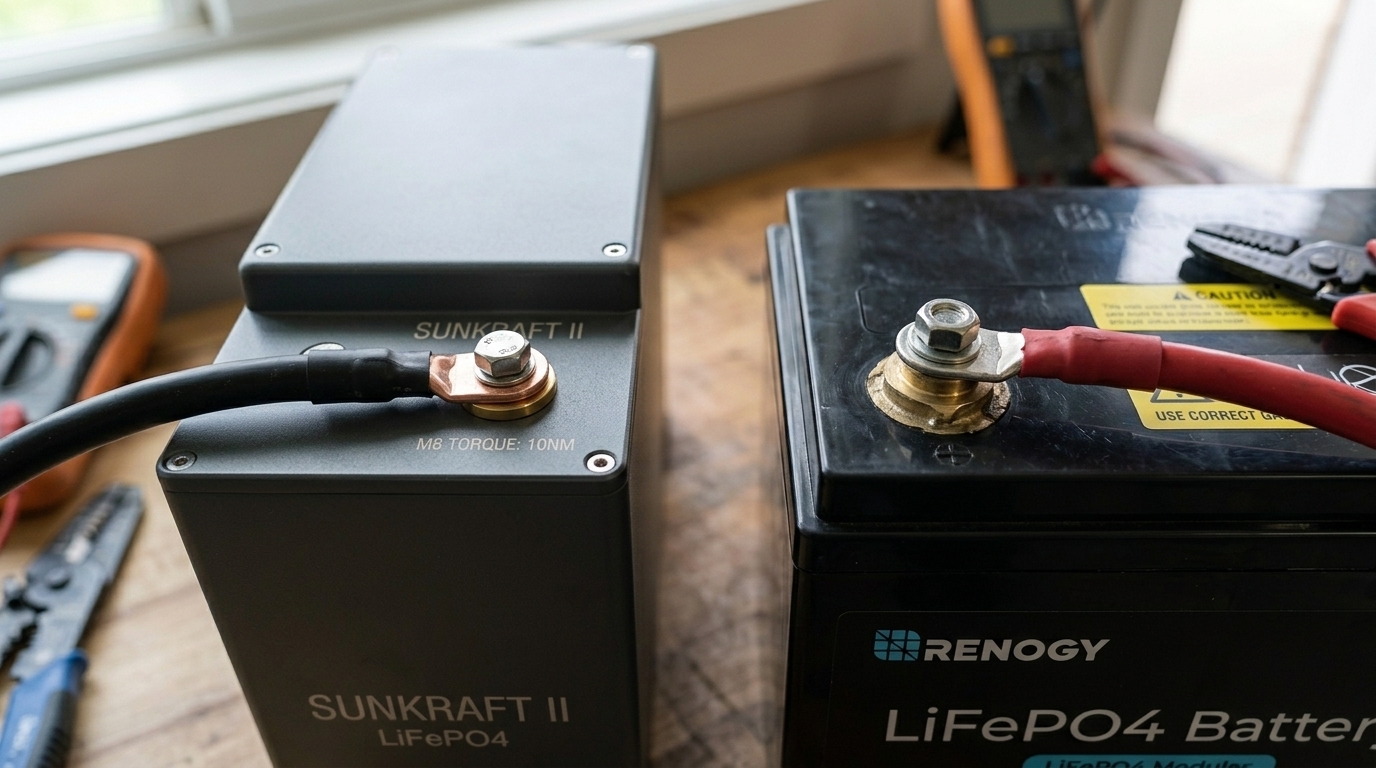
The terminal posts feel slightly cheaper than the LiTime or SOK. They work fine, but the machining isn’t as clean.
Documentation is minimal — a single-page quick start guide. If you’re new to LiFePO4, the LiTime or SOK come with better instructions.
Verdict: The right choice when every dollar matters and you just need functional LiFePO4 cells in a box. Not the battery to build your dream system around, but solid for the price.
5. Battleborn 100Ah 12V — The Legacy Pick
Price: ~$840 | Energy: 1.27 kWh | $/kWh: ~$331
I’m including Battleborn because they’re still widely recommended, and I want to be honest about where they stand in 2026.
What I measured:
- Actual capacity at 0.2C: 99Ah (99% of rated — very accurate)
- BMS cutoff voltage: 10.0V low, 14.6V high
- BMS continuous: 100A
- Low-temperature cutoff: Activates at 3°C (37°F)
What I like:
Battleborn practically created the consumer LiFePO4 market. They have a proven track record going back to 2016, a responsive US-based support team, and a clean, well-built product. The actual capacity matches the rated capacity almost exactly, which shows excellent QC.
The 10-year warranty is the longest in the 12V consumer space. If longevity is your primary concern, Battleborn’s track record is reassuring.
They’re also the most widely stocked battery in RV and marine shops, so if you need one tomorrow, you can probably find it locally.
What I don’t like:
The price. At $331/kWh, Battleborn costs 3.5x more per kWh than LiTime and 4.2x more than Redodo. For the same $840, you could get almost two LiTime 200Ah batteries with nearly four times the total capacity.
100Ah is small by today’s standards. You need four Battleborn batteries in series to match a single 48V EG4 LL-S 100Ah setup, and you’d spend $3,360 to do it.
No Bluetooth, no app, no built-in heating on the standard model (the heated version exists but costs even more).
In 2020, Battleborn was the safe choice because the alternatives were untested Chinese brands with questionable BMS quality. In 2026, LiTime, SOK, and EG4 have all proven themselves with years of community data. Battleborn’s premium no longer buys you meaningfully more reliability.
Verdict: A good battery that’s no longer a good value. If you’re starting fresh in 2026, your money goes further elsewhere.
6. EG4 LL 48V 280Ah — Best for Large Systems
Price: ~$2,499 | Energy: 14.1 kWh | $/kWh: ~$88
The big brother of the LL-S. This is a 280Ah, 48V server-rack battery that weighs 245 pounds and delivers over 14 kWh in a single unit.
What I measured (from community data and a friend’s system):
- Actual capacity: 276Ah (98.6% of rated)
- BMS continuous: 200A (10.2 kW)
- Built-in heating: Yes
- CAN bus: Yes
What I like:
The $/kWh is the lowest of any pre-built option at $88/kWh. That’s genuinely approaching DIY raw-cell territory, and you get a factory-assembled pack with warranty and support.
200A continuous BMS means a single unit can support a 6kW inverter at full output without breaking a sweat. No need to parallel multiple batteries just to hit your current requirement.
14.1 kWh in a single unit means fewer connections, fewer points of failure, and simpler wiring.
What I don’t like:
It weighs 245 pounds. You need two people and a plan to get this into your battery rack. My friend and I used a furniture dolly and it was still a workout.
The price is $2,499 at once, which is a bigger single purchase than four $440 LiTime units even though the per-kWh cost is lower.
If the BMS fails, you’ve lost 14 kWh at once rather than one battery out of several.
Verdict: The best value pre-built battery for large systems. If you can handle the weight and the upfront cost, it’s the most energy for the dollar in a ready-made package.
Winners by Category
Best Overall: EG4 LL-S 48V 100Ah
The right balance of capacity, BMS quality, form factor, and price for most DIY solar builders going 48V. Buy two, stack them, and you have a 10.4 kWh bank that communicates with your inverter over CAN bus.
Best Budget: LiTime 12V 200Ah
Proven, affordable, and available. Get the Bluetooth version. Wire four in series for 48V or use them as-is for 12V systems.
Best for Server Rack Builds: EG4 LL 48V 280Ah
Lowest $/kWh in a pre-built package. One unit does what would take 6-8 individual 12V batteries. If you’re building a 15+ kWh system and want to keep things simple, this is it.
Best 12V Battery: SOK 206Ah
Superior BMS (150A continuous), accurate capacity, built-in Bluetooth, and a company with a solid reputation. Worth the premium over LiTime if you’re building a quality 12V system.
Best Ultra-Budget: Redodo 12V 200Ah
When every dollar counts and you just need working LiFePO4 storage, Redodo delivers. Not fancy, but functional at the lowest price point I’d recommend.
What About Building Your Own?
If you’re comfortable with electrical work and want the absolute lowest cost per kWh, building from raw prismatic cells is still the way to go. A 48V 280Ah DIY build from EVE cells with a JK BMS runs about $1,500-1,800, which is $105-126/kWh with full control over every component.
The tradeoff is time, complexity, and no warranty on the assembled pack. We have a complete walkthrough in our DIY LiFePO4 battery bank guide if you want to go that route.
How to Size Your Battery Bank
The right battery isn’t just about which brand — it’s about how much capacity you need. That depends on:
- Your daily energy consumption
- How many days of autonomy you want (cloudy days without solar production)
- Your inverter’s maximum draw
- Your charge controller’s capacity
Plug your numbers into the Battery Bank Calculator to get a specific recommendation, or follow our battery bank sizing guide for worked examples. If you’re sizing panels to match, the solar panel sizing guide covers the full calculation. As a rough starting point, most homes need 10-20 kWh of usable battery storage to cover overnight usage and one cloudy day.
Final Advice
Don’t overthink the battery choice. Any battery on this list (except maybe Battleborn at its current pricing) represents good value. The bigger decisions are how much total capacity you need and whether to go 12V, 24V, or 48V.
For systems over 2,000W, go 48V. It simplifies wiring, reduces current, and gives you access to better inverter options — our panel wiring guide explains why higher voltage means smaller, cheaper cables throughout the system. For small systems (shed, RV, boat), 12V is fine and gives you the most battery options — our RV and van solar build guide covers the best 12V picks for mobile installs.
Whatever you choose, make sure your wiring is properly sized (use the Wire Gauge Calculator), your fusing is adequate, and your charge parameters are set correctly for LiFePO4 — wrong absorption or float voltages are a leading cause of batteries that won’t charge from solar. A $400 battery wired with undersized cable is a worse investment than a $600 battery wired correctly.
To see how battery costs fit into your total project budget — including the 30% federal tax credit that applies to battery storage — run your numbers through the Cost Estimator.
Frequently Asked Questions
What is the best LiFePO4 battery for solar in 2026?
The EG4 LL-S 48V 100Ah is the best overall pick for most DIY solar builders. It offers a strong BMS, built-in heating for cold climates, server rack form factor, and a competitive price at about $120/kWh. On a budget, the LiTime 12V 200Ah delivers solid performance at roughly $90/kWh.
How much do LiFePO4 batteries cost per kWh?
Pre-built LiFePO4 batteries range from $78/kWh (Redodo 12V 200Ah) to $331/kWh (Battleborn 100Ah). The sweet spot for most builders is $88-$120/kWh with EG4 server rack batteries. Building from raw cells costs $100-$110/kWh.
Is Battleborn still worth buying in 2026?
Battleborn batteries are well-made with excellent QC, but at $331/kWh they cost 3.5-4x more per kWh than competitors like LiTime or Redodo. The premium no longer buys meaningfully more reliability since brands like LiTime, SOK, and EG4 now have years of proven community data.
Should I buy 12V or 48V LiFePO4 batteries?
For systems over 2,000W, go 48V. It simplifies wiring, reduces current (which means smaller cheaper cables), and gives you access to better inverter options. For small systems like sheds, RVs, or boats, 12V is fine and offers the most battery choices.
How do I test LiFePO4 battery capacity?
Fully charge the battery to the manufacturer's cutoff voltage, then discharge at 0.2C rate to the low-voltage cutoff while measuring total Ah delivered. Compare against the rated capacity. Most quality batteries deliver 95-102% of their rated Ah.
Anthony
Solar homeowner, EV driver, and DIY builder. Using solar to power a large part of my home.
Get build guides in your inbox
Weekly solar builds, product tests, and technical deep-dives.
Subscribe Free