How to Size a Solar Battery Bank: LiFePO4 Sizing Guide

Short answer: Size your LiFePO4 battery bank with this formula — Bank Ah = (Daily kWh × Days of Autonomy) / (DoD × Inverter Efficiency × Nominal Voltage). For a 10 kWh/day load with one day of autonomy, 80% DoD, 92% inverter efficiency, and a 48V bank, that’s (10,000 × 1) / (0.80 × 0.92 × 51.2) = 265 Ah at 48V, or about 13.6 kWh of nameplate capacity. Round up to the next standard battery size and you’re done.
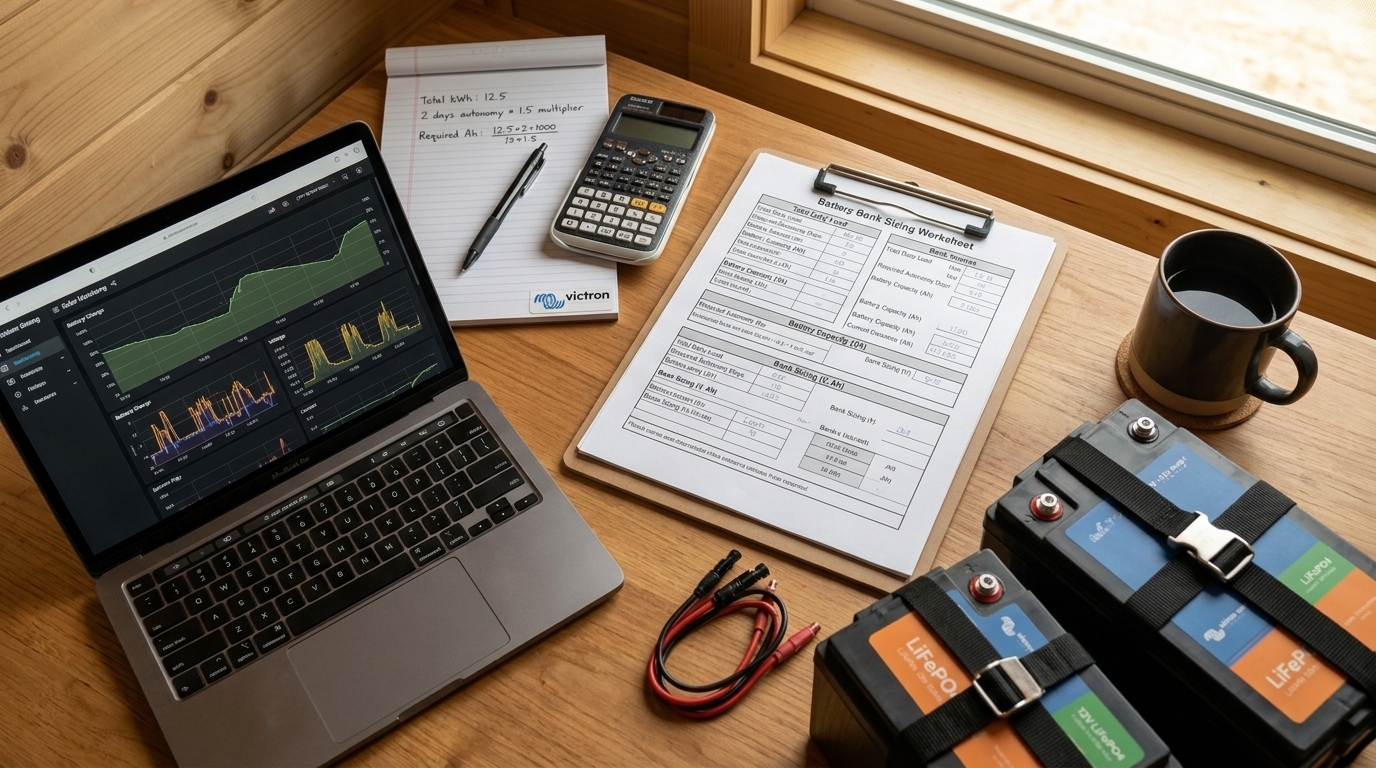
Sizing is the single decision that determines whether your solar system works or frustrates you for the next decade. Undersize and you’ll be watching the SOC drop every cloudy afternoon. Oversize and you waste thousands of dollars on cells that never get used. I’ll walk you through the math I use on every system I design, with three worked examples at the end.
If you’d rather skip the arithmetic, plug your numbers into the Battery Bank Calculator and jump to the voltage-choice section. But honestly, understanding the formula takes 10 minutes and pays off every time you compare batteries.
What Does “Sizing” Actually Mean?
A battery bank has two specs that matter for sizing: energy capacity (kWh, how much total energy it stores) and power capacity (kW, how fast it can deliver that energy). Sizing means matching both to your loads with enough margin for real-world losses and bad weather.
Most homeowners focus only on energy capacity. That’s usually fine — LiFePO4 battery banks are typically power-oversized for residential loads. But if you run a welder, an EV charger, or a well pump on batteries, you have to check the discharge current rating too.
The rest of this guide walks through the six variables in the sizing formula, shows how they interact, and applies them to three common scenarios.
Step 1: How Much Energy Do You Actually Use?
Everything downstream depends on getting this number right. You have three ways to measure it:
Option A — Read the meter. If you’re grid-tied, your utility bill shows monthly kWh. Divide by 30 to get daily average. My house in Rhode Island averages about 32 kWh/day across the year, with summer peaks around 55 kWh (AC) and winter lows around 22 kWh.
Option B — Whole-house monitor. An Emporia Vue or Sense monitor gives you hourly and per-circuit data. This is what I’d recommend if you’re planning a partial backup setup, because it tells you exactly which circuits drive your usage.
Option C — Load audit. For off-grid planning, build a spreadsheet: every device × wattage × hours/day. Sum the watt-hours and divide by 1000 for kWh. This is the only honest way to size a brand-new off-grid cabin that’s never been metered.
Sample Load Audit (Small Off-Grid Cabin)
| Load | Watts | Hours/day | Wh/day |
|---|---|---|---|
| LED lights (×6) | 60 | 4 | 240 |
| Chest freezer | 80 avg | 24 | 1,920 |
| Water pump | 300 | 0.5 | 150 |
| Laptop + Wi-Fi | 40 | 6 | 240 |
| Fridge (12V compressor) | 45 avg | 24 | 1,080 |
| Phantom/parasitic | 20 | 24 | 480 |
| Microwave | 1000 | 0.1 | 100 |
| Total | 4,210 Wh (≈ 4.2 kWh) |
That cabin needs roughly 5 kWh/day of capacity when you round up for the stuff you forgot. Always round up. You forgot something.
Step 2: How Many Days of Autonomy Do You Need?
Days of autonomy is the question: how many days can my bank run the loads with zero solar input? It’s the single biggest lever in the sizing equation, because doubling autonomy doubles the battery cost.
| System Type | Typical Autonomy |
|---|---|
| Grid-tied whole-home backup | 0.5-1 day |
| Grid-tied essentials backup | 1-2 days |
| RV / van life (with driving recharge) | 1-2 days |
| Off-grid cabin (seasonal, sunny) | 1-2 days |
| Full-time off-grid (mixed weather) | 2-3 days |
| Full-time off-grid (cloudy climate) | 3-5 days + generator |
More than about three days of autonomy and you’re usually better off with a smaller bank plus a generator or extra panels. I ran the numbers for a friend’s place in Vermont last fall — going from 2 to 5 days of autonomy would have cost him an extra $9,000 in batteries versus $1,800 for a propane generator that runs maybe 40 hours a year.
Step 3: What’s Your Usable Depth of Discharge?
Depth of discharge (DoD) is the fraction of the bank’s nameplate capacity you actually use before recharging. For LiFePO4 the sweet spot is 80% DoD — at that depth, quality cells deliver 3,000-6,000 cycles to 80% remaining capacity.
Can you go deeper? Yes. LiFePO4 will happily deliver 95%+ DoD without immediate damage, but cycle life drops. The tradeoffs:
| DoD | Cycles to 80% Capacity | Years at Daily Cycling |
|---|---|---|
| 100% | 2,000 – 3,000 | 5.5 – 8 |
| 80% | 3,000 – 6,000 | 8 – 16 |
| 50% | 6,000 – 10,000+ | 16 – 27 |
I design to 80% for daily-cycling systems and 50% for backup-only systems that rarely discharge. The extra capacity you buy at 50% DoD pays itself back in calendar years of service.
Step 4: How Much Does the Inverter Steal?
Every inverter loses some energy as heat. Pull 1000W from the AC side and the inverter pulls roughly 1060-1110W from the battery. That efficiency factor has to go into your sizing math because the nameplate kWh on your battery is DC energy — your loads are AC.
Typical inverter efficiency numbers (from spec sheets I’ve actually verified against a shunt):
- Cheap modified-sine inverters: 80-85%. Don’t use these on a battery bank you care about.
- Entry-level pure-sine: 88-92%.
- Quality hybrid inverters (EG4 18kPV, Victron MultiPlus, Sol-Ark): 92-95% peak, 90-93% averaged across real loads.
- High-end low-frequency inverters (Outback, Schneider): 93-96%.
For sizing math, I plug in 0.92 as a reasonable average. If you already own the inverter, use its CEC weighted efficiency from the datasheet instead.
Don’t forget parasitic draw: every inverter burns 15-60W just being on, 24/7. That’s 0.4-1.4 kWh/day gone before you plug in a single thing. On small systems this is a larger slice than you’d think. If you’re comparing portable plug-and-play options to a permanent build, the portable power stations vs DIY comparison breaks down how these losses stack up differently between the two approaches.
Why Does Voltage Matter for Sizing?
You’ll size the same kWh whether you build a 12V, 24V, or 48V bank — but the Ah rating, wire size, and parts list change dramatically. Here’s the relationship:
- 12V bank (4S LiFePO4): nominal 12.8V, practical up to ~1,500W inverter
- 24V bank (8S LiFePO4): nominal 25.6V, practical up to ~3,000W inverter
- 48V bank (16S LiFePO4): nominal 51.2V, practical from 3,000W to 20,000W+
Higher voltage = lower current for the same power. And lower current is good for everything: smaller (cheaper) wires, lower I²R losses, access to better charge controllers and inverters. Compare:
| System | Power | Current | Minimum Cable |
|---|---|---|---|
| 12V | 3,000W | 250A | 4/0 AWG |
| 24V | 3,000W | 125A | 1 AWG |
| 48V | 3,000W | 62.5A | 4 AWG |
That’s why I tell everyone building above 3 kW to skip straight to 48V. You’ll spend less on copper, the charge controller options get cheaper per watt, and inverters in the 5-15 kW range are almost all 48V-native. Double-check all your runs with the solar wire gauge chart once you’ve settled on a voltage.
The trade-off: 48V needs 16 cells in series, which means a more involved build. The DIY LiFePO4 battery bank guide walks through the 16S assembly in detail.
How Does Temperature Affect Battery Sizing?
LiFePO4 cells publish capacity at 25°C. At 0°C, usable capacity drops 10-20%. Below freezing, charging is blocked entirely to prevent lithium plating — the Battery University cold-temperature reference is the standard explanation for why.
If your batteries live in an unconditioned space that sees winter cold, apply a temperature derate factor to your sizing:
| Expected Battery Temperature | Derate Factor |
|---|---|
| 20-25°C (ideal) | 1.00 |
| 10-15°C | 0.95 |
| 0-5°C | 0.85 |
| -10°C | 0.75 |
My own bank lives in an insulated basement that stays 55-65°F year-round, so I don’t derate. A friend’s bank in an unheated New Hampshire shed needed an extra 20% of nameplate capacity to deliver rated energy in February.
Alternatively, buy batteries with built-in self-heating (the EG4 LL-S is the one I see most often) or install heating pads wired through the BMS low-temp signal. If your bank mysteriously stops accepting charge on cold mornings, the battery not charging diagnostic guide walks through BMS low-temp lockouts step by step.
The Complete Sizing Formula
Putting it all together:
Bank Capacity (Ah) = (Daily kWh × Days of Autonomy × 1000)
                     ÷ (DoD × Inverter Efficiency × Temperature Factor × Nominal Voltage)
And the nameplate energy you need to buy:
Bank Capacity (kWh) = (Daily kWh × Days of Autonomy)
                      ÷ (DoD × Inverter Efficiency × Temperature Factor)
That second version is easier because you can shop batteries directly in kWh. I use both — the Ah version tells me what to build, the kWh version tells me what to buy.
Example 1: Off-Grid Cabin (5 kWh/day)
A weekend cabin in upstate New York. Loads: LED lighting, compressor fridge, water pump, laptops, occasional microwave. Measured load: 5 kWh/day. Two days of autonomy (the owner doesn’t want to worry about one cloudy weekend). 48V bank, 92% inverter, 0.90 temperature factor (garage install, cold winters), 80% DoD.
kWh needed = (5 × 2) / (0.80 × 0.92 × 0.90) = 15.1 kWh
Ah at 48V  = 15,100 / 51.2 = 295 Ah
Round up to the next standard size: one EG4 LL 48V 280Ah unit (14.3 kWh) is very close, or three 100Ah 48V server rack batteries (15.4 kWh) gives a little headroom. I’d go with three 100Ah units for the cabin — it’s easier to carry three 100-lb batteries upstairs than one 245-lb unit.
Example 2: RV / Van Build (2 kWh/day)
A sprinter van with a 12V house system: DC fridge, diesel heater (DC fuel pump and fan), LED lights, Starlink, MacBook charging, occasional 700W induction cooktop via inverter. Measured: 2 kWh/day. One day of autonomy (the van drives most days, recharging via DC-DC and a 400W rooftop array). 12V bank, 90% inverter efficiency (includes the induction hit), 1.0 temperature factor (inside the living space), 80% DoD.
kWh needed = (2 × 1) / (0.80 × 0.90 × 1.0) = 2.78 kWh
Ah at 12V  = 2,780 / 12.8 = 217 Ah
One LiTime 12V 200Ah (2.56 kWh) is a hair short but realistic for daily cycling. Two of them in parallel gives you 400Ah / 5.12 kWh with huge margin — which is what I’d actually recommend because van electrics always grow over time. For specific battery model picks at this size, see the 2026 LiFePO4 battery roundup.
Example 3: Whole-Home Backup (20 kWh/day)
A 2,400 sq ft home, grid-tied hybrid inverter, one day of autonomy target. Measured average: 20 kWh/day (heat pump, induction stove, normal loads). 48V bank, 93% inverter (Sol-Ark 15K or EG4 18kPV class), 1.0 temperature factor (conditioned basement), 80% DoD.
kWh needed = (20 × 1) / (0.80 × 0.93 × 1.0) = 26.9 kWh
Ah at 48V  = 26,880 / 51.2 = 525 Ah
Two EG4 LL 48V 280Ah units in parallel (28.6 kWh) covers it almost exactly. Or four server-rack 100Ah/48V units (20.5 kWh) plus a willingness to shed the heat pump during outages. The second option is what I’d pick for a grid-tied household that’s really using batteries as insurance — most outages are under 8 hours and don’t need 27 kWh.
What About Cycles and Lifetime Cost?
Cycle life is the last thing to factor in, and it’s where LiFePO4 earns its keep. At 80% DoD, quality cells deliver 3,000-6,000 cycles before dropping to 80% of original capacity — that’s 8-16 years of daily cycling. An underbuilt bank that runs to 100% DoD every day drops to the 2,000-3,000 cycle range, shaving 30-40% off service life.
Lifetime cost per kWh delivered is what matters. A $1,500 14 kWh DIY bank at 80% DoD delivering 4,000 cycles yields:
14 kWh × 0.80 × 4,000 cycles = 44,800 kWh delivered
$1,500 / 44,800 = $0.033 per kWh
Three cents per kWh of storage. That’s why I keep saying “oversize slightly” — the incremental capacity is nearly free on a per-cycle basis, and you get longer calendar life out of the deal.
The U.S. Department of Energy’s residential storage guide covers the economics in more depth if you want the policy-level view.
Series/Parallel: Hitting Your Target Voltage
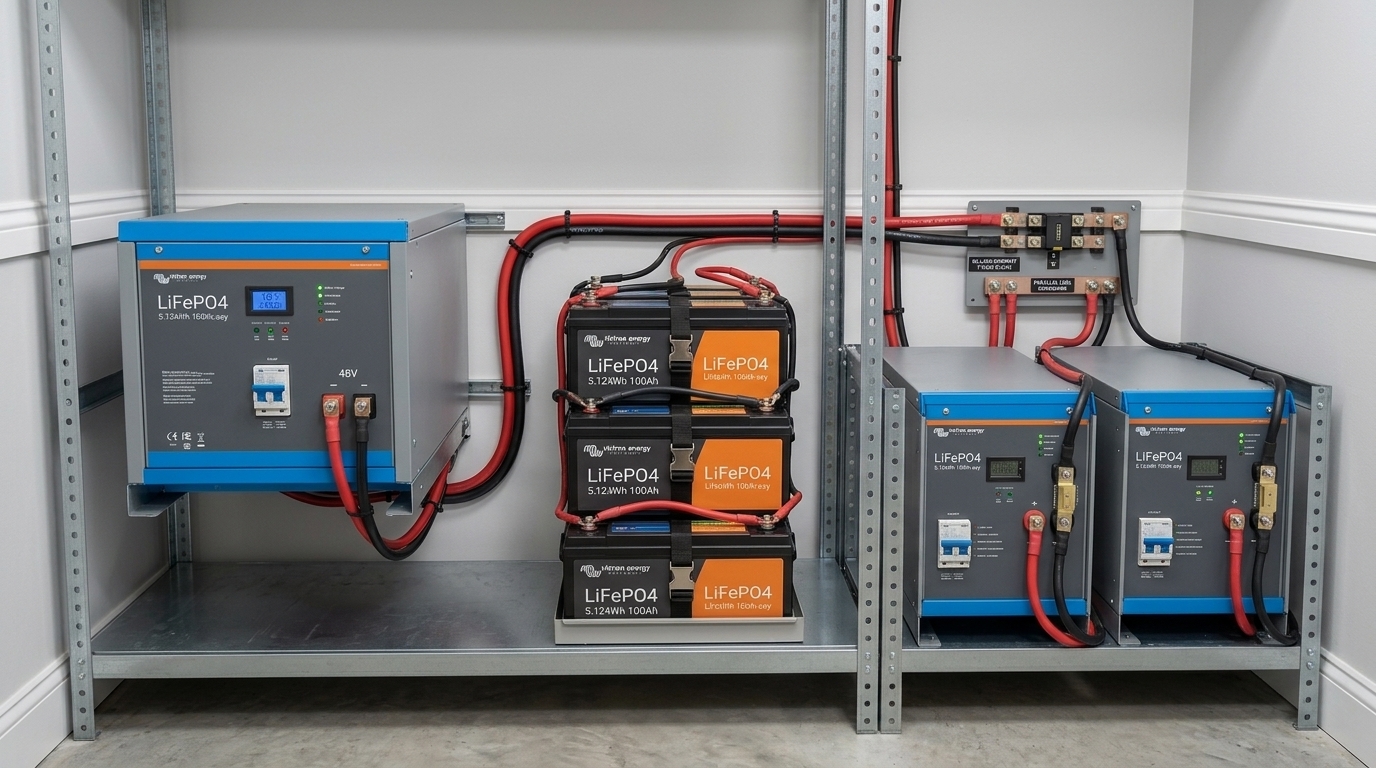
Once you know kWh and voltage, the last step is wiring cells or batteries to match.
From raw prismatic cells (3.2V nominal):
- 4S = 12.8V nominal, needs a 4S BMS
- 8S = 25.6V nominal, needs an 8S BMS
- 16S = 51.2V nominal, needs a 16S BMS
From pre-built 12V batteries: wire 4 in series for a 48V bank, or 2 in series for 24V. All batteries in a series string must be the same model, same age, and charged to within 0.1V of each other before you connect them — otherwise the BMS on the low battery will lock out the whole string.
Parallel strings add capacity at the same voltage. Each parallel string needs its own fuse as close to the positive terminal as possible. Two parallel strings of 4S 100Ah 12V batteries = 48V, 200Ah, 10.24 kWh total. This is the configuration I’d pick for a medium whole-home backup if you can’t find one big server-rack unit that matches your target.
If you’re designing the full system, run the final numbers through the Battery Bank Calculator — it handles all the derates automatically and spits out a shopping list.
Common Sizing Mistakes I See
The same handful of mistakes keep showing up in sizing discussions:
- Using nameplate instead of usable. A “200Ah” battery at 80% DoD is 160Ah usable. People forget and undersize by 20%.
- Forgetting inverter parasitic load. 30W × 24h = 720 Wh/day gone. On a 2 kWh/day system that’s a third of your budget.
- Ignoring future loads. The heat pump water heater you’re planning for next year. The EV. Size the bank, charge controller, and inverter with 20-30% headroom for growth.
- Sizing for summer only. Winter sun hours are 30-60% of summer in most of the US. Your bank needs to survive the shortest days, not the longest.
- Mixing old and new batteries in parallel. Don’t. The newer pack carries more current and ages faster until they match again — usually in a bad way.
- Skipping the voltage decision. Buying 12V because “that’s what RVs use” and then wishing you had 48V when the inverter hits 3 kW.
Putting It All Together
The formula handles the numbers. The judgment calls are: how many days of autonomy (pick the lowest number you can live with), what DoD target (80% unless you enjoy replacing batteries), and what voltage (48V for anything permanent above 3 kW).
Measure first. Calculate second. Then buy 20% more capacity than the calculation says, because you always forget something and the marginal cost per cycle is trivial. On my own system, I sized for 2 days of autonomy on an 18 kWh/day winter load, landed at 32 kWh of nameplate capacity, and have been quietly grateful for the buffer every ice storm since.
If you’re ready to start shopping, head over to the best LiFePO4 batteries for 2026 roundup for specific model picks at every size. And if you’re going the DIY route with raw cells, the DIY LiFePO4 battery bank build guide is the next step after sizing.
Frequently Asked Questions
How many kWh of battery do I need for a 2000 square foot house?
A typical 2000 sq ft home uses 25-35 kWh per day. For one day of whole-home backup at 80% depth of discharge with a 92% efficient inverter, you need roughly 34-48 kWh of nameplate LiFePO4 capacity. For essentials only (fridge, lights, internet, a few circuits), 10-15 kWh is usually plenty.
Is it better to oversize or undersize a battery bank?
Oversize slightly. An undersized bank cycles deeper every day, which shortens its life and leaves you short during bad weather. A bank sized 20-30% above your calculated need runs at shallower DoD, lasts longer, and gives you a buffer for cloudy stretches. Going dramatically oversized wastes money and may never fully recharge in winter.
Should I build a 12V, 24V, or 48V battery bank?
Use 12V only for systems under about 1500W (small RVs, vans, cabins). Use 24V for 1500-3000W systems. Use 48V for anything above 3000W, including all whole-home backup. Higher voltage means lower current, smaller wires, less loss, and access to the best inverter and charge controller options.
How many days of autonomy should I plan for?
One day is the minimum for grid-tied backup. Two days is the sweet spot for off-grid cabins in sunny climates. Three days is appropriate for full-time off-grid in cloudy regions like the Pacific Northwest or New England. Beyond three days, a small generator is almost always cheaper than more batteries.
Does cold weather reduce my usable battery capacity?
Yes. LiFePO4 loses about 10-20% of usable capacity at 0°C and more below that. Charging is blocked entirely below freezing to prevent lithium plating. If your batteries will see sub-freezing temperatures, either choose batteries with built-in heating or plan to install them in conditioned space, and add 15-20% to your sizing calculation.
Can I add more batteries to my bank later?
Yes, but with caveats. New LiFePO4 batteries should match existing ones in chemistry, voltage, capacity, and ideally age. Mixing old and new batteries in parallel causes the newer ones to carry more of the load and ages them faster. If you expect to expand, buy your charge controller and inverter oversized from the start so the electronics can handle the bigger future bank.
Anthony
Solar homeowner, EV driver, and DIY builder. Using solar to power a large part of my home.
Get build guides in your inbox
Weekly solar builds, product tests, and technical deep-dives.
Subscribe Free