Portable Power Stations vs DIY Solar: When Each Makes Sense
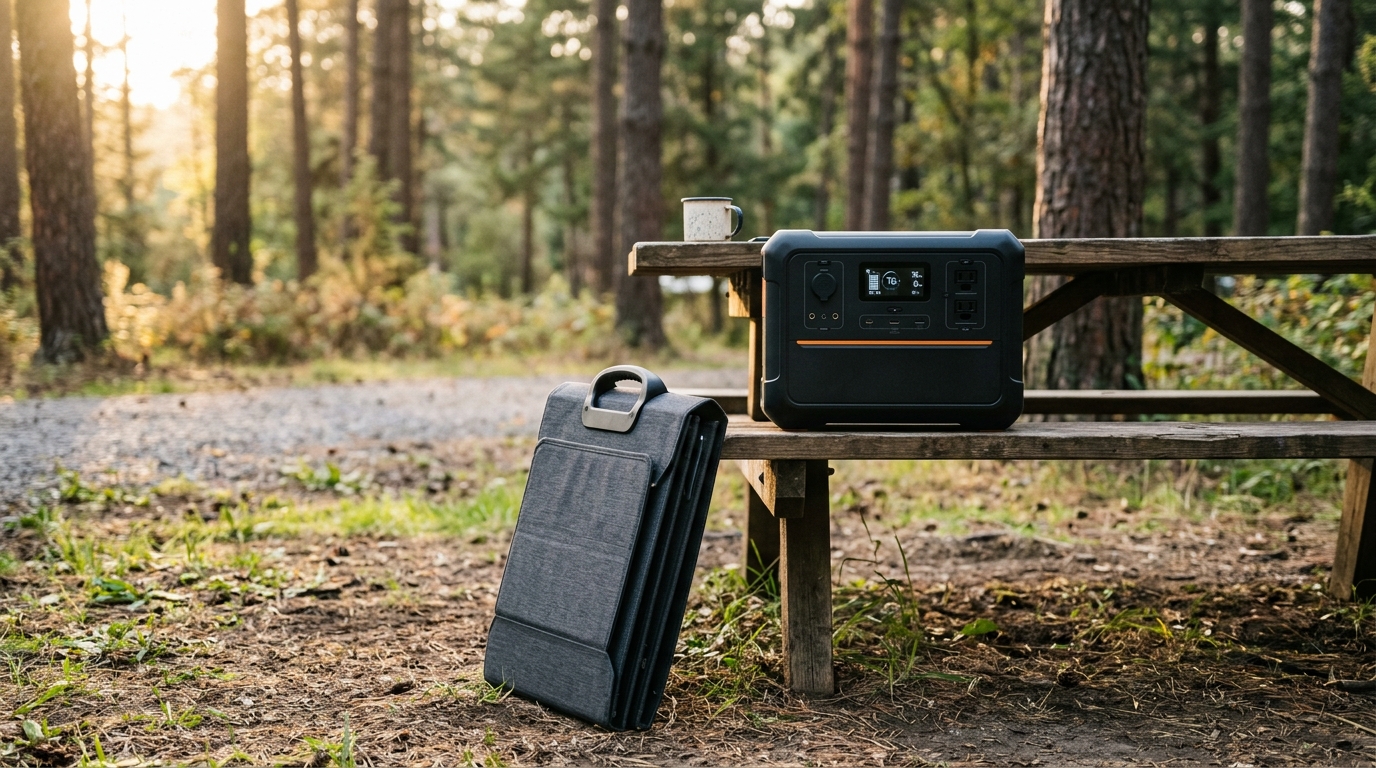
Key takeaway: Portable power stations and DIY solar systems solve different problems. Portables win on convenience, portability, and zero-expertise startup. DIY wins on cost per kWh ($100-200/kWh vs $300-500/kWh), total capacity, expandability, and long-term value. Most people who get serious about solar start with a portable and graduate to DIY once they realize they need more capacity or lower costs. If you just need backup for a fridge and some lights, a portable might be all you ever need. If you want to run your whole house off-grid or slash your electric bill, DIY is the path.
Why This Comparison Matters
I get this question constantly: “Should I just buy an EcoFlow Delta Pro, or should I build my own system?” The answer depends on what you’re trying to accomplish, how much effort you want to invest, and your budget horizon.
I own both. A portable power station for camping and emergency backup, and a full DIY 48V LiFePO4 system with an EG4 6000XP inverter powering most of my house. They serve completely different purposes, and I wouldn’t trade either one. But if I could only have one, it would be the DIY system — by a wide margin.
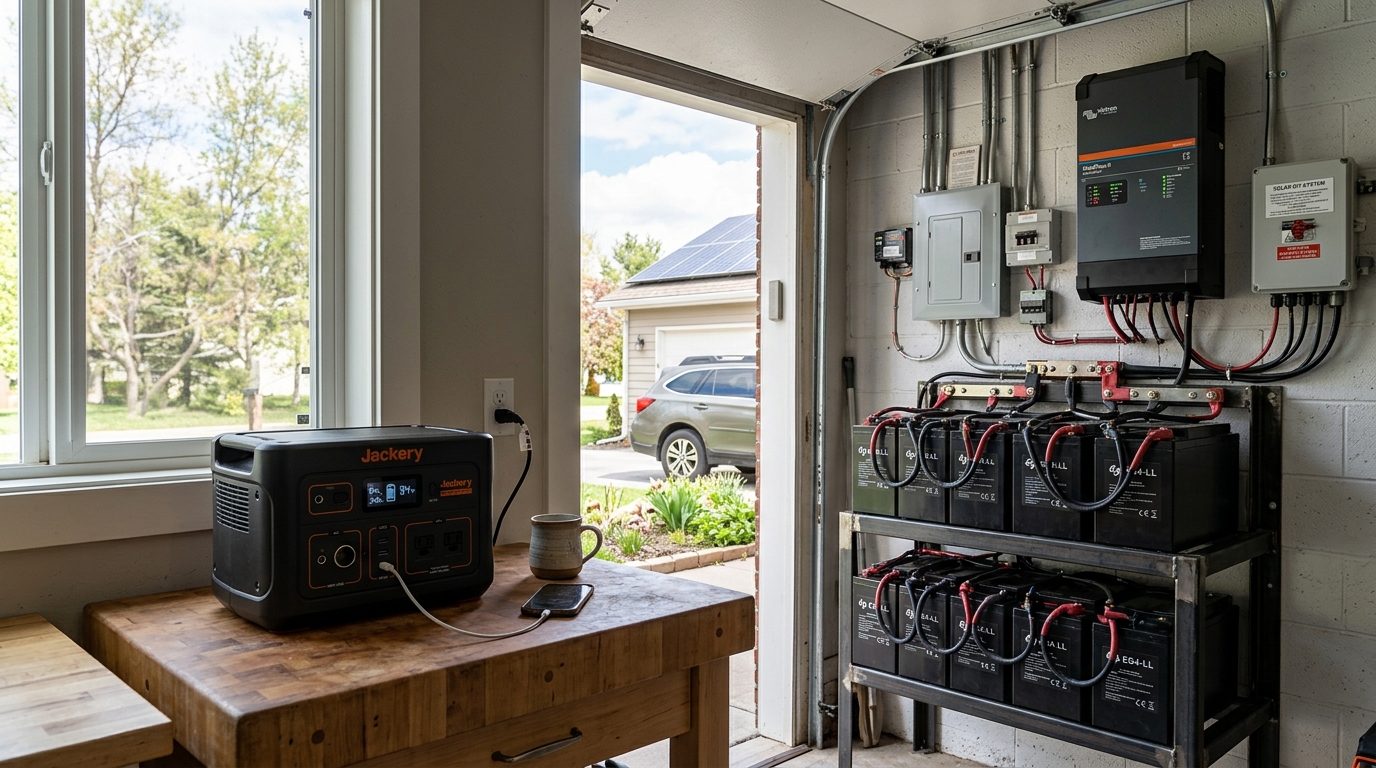
Here’s the honest breakdown.
The Cost Per kWh Reality
This is the single biggest factor for most people, and it’s where DIY pulls far ahead.
Portable Power Station Costs
| Product | Capacity | Street Price (2026) | Cost per kWh |
|---|---|---|---|
| Jackery Explorer 2000 Plus | 2.04 kWh | $1,299 | $637/kWh |
| EcoFlow Delta Pro | 3.6 kWh | $1,799 | $500/kWh |
| Bluetti AC200MAX | 2.05 kWh | $1,299 | $634/kWh |
| EcoFlow Delta Pro Ultra | 6.0 kWh | $2,799 | $467/kWh |
| Bluetti EP500Pro | 5.1 kWh | $2,999 | $588/kWh |
The pattern is clear: even the best-value portables cost $400-650 per usable kWh. Expansion batteries bring the marginal cost down somewhat (EcoFlow’s extra batteries run about $250-300/kWh), but the base unit always includes the inverter cost, so the overall system price stays high.
DIY LiFePO4 System Costs
A complete DIY system — panels, charge controller, inverter, batteries, wiring, and BMS — typically runs $150-250 per kWh of battery storage, depending on component choices. The battery cost alone is $80-150/kWh depending on whether you buy pre-built batteries or assemble from raw cells.
| Component | Cost Range (5 kWh system) | Cost Range (10 kWh system) |
|---|---|---|
| LiFePO4 batteries | $500-750 | $900-1,400 |
| Inverter (EG4 6000XP) | $1,400-1,600 | $1,400-1,600 |
| Solar panels (2-4 kW) | $400-800 | $600-1,200 |
| Charge controller (if separate) | $150-400 | $150-400 |
| Wiring, breakers, fuses, misc | $200-400 | $300-500 |
| Total | $2,650-3,950 | $3,350-5,100 |
| Cost per kWh of storage | $530-790/kWh | $335-510/kWh |
Wait — that per-kWh number looks similar to the portables for a 5 kWh system. And that’s a fair observation for small systems. When your system is small, the fixed costs (inverter, charge controller, wiring) dominate, and you’re paying a lot per kWh.
But here’s the difference: scaling a DIY system costs only the marginal battery price. Adding another 5 kWh to the DIY system costs $500-750 for batteries and maybe $50 in extra cables. Adding 5 kWh to an EcoFlow Delta Pro costs $2,000+ for expansion batteries — if expansion is even supported.
At 10 kWh and above, DIY costs $100-200/kWh while portable systems (if you can even get there) cost $350-500/kWh. At 20 kWh, DIY is under $150/kWh and portable options essentially don’t exist.
Use the Cost Estimator to price out a DIY system for your specific needs. Factor in the federal solar tax credit — it applies to DIY installations per IRS Section 25D and knocks 30% off the total system cost.
When a Portable Power Station Is the Right Choice
I’m not here to trash portables. They fill real needs that DIY doesn’t address well.
Camping and Mobile Use
This is the portable’s home turf. A good portable goes on every camping trip — running a 12V fridge, charging phones and laptops, powering LED lights, and running a small fan for 3-4 days off a single charge with a 200W portable solar panel topping it up during the day.
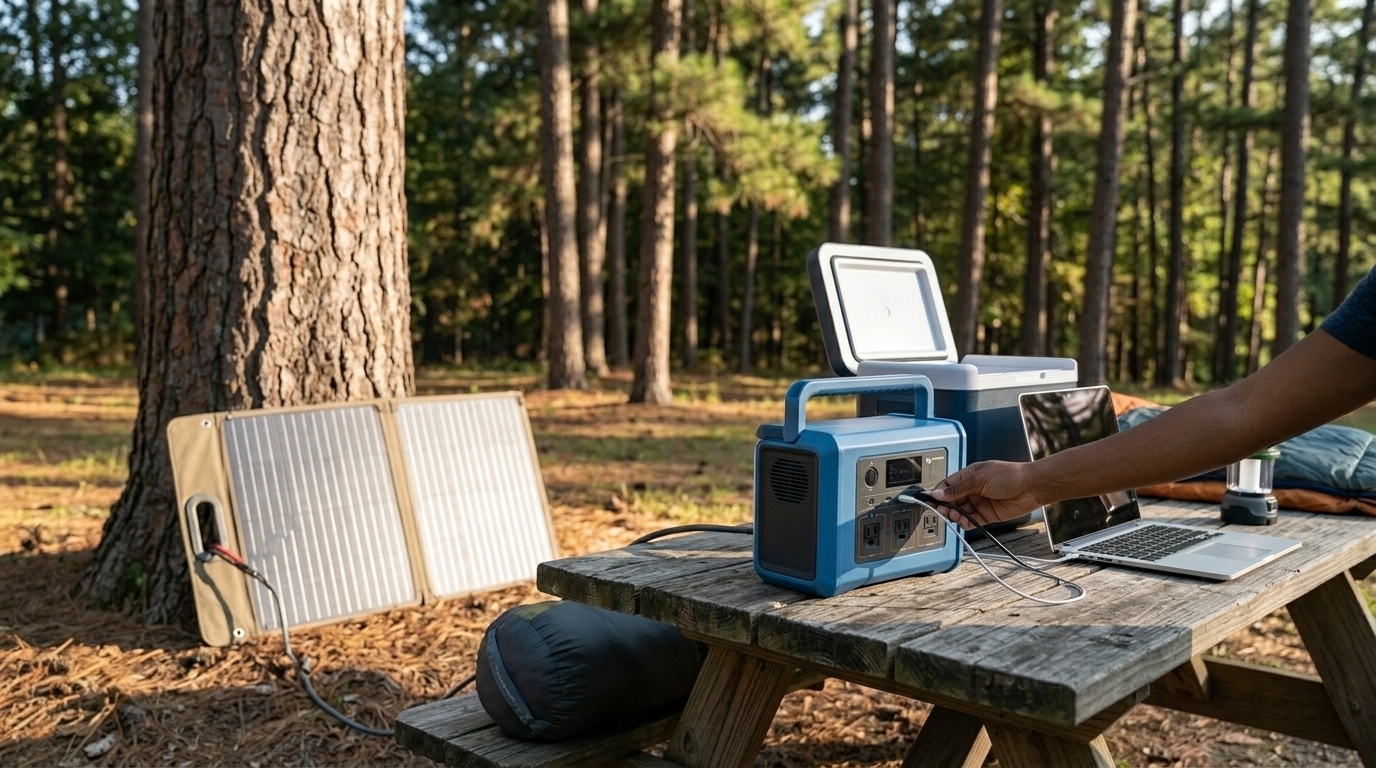
Building a “portable” DIY system is possible but impractical — though our RV and van solar build guide shows how to do it cleanly for a fixed mobile install. You’re dealing with loose batteries, a separate inverter, bare wiring, and components that aren’t designed to be tossed in a truck bed. A portable power station is a sealed, integrated unit with a handle. Pick it up and go.
Apartment Dwellers and Renters
If you rent and can’t mount panels on the roof or run wiring through walls, a portable power station with a balcony solar panel is your only realistic option. You can charge it from the wall outlet (basically using it as a UPS for power outages) or from a small portable panel on the balcony or in a window.
A portable with a 200W panel on the balcony covers emergency backup needs, and when you move, everything comes with you in two trips.
Small-Scale Emergency Backup
If your goal is to keep a fridge, a few lights, and phone chargers running during a 6-24 hour power outage — and that’s it — a single portable power station handles that for $1,000-2,000. A 2-3 kWh unit will run a modern efficient refrigerator for 12-20 hours and charge your phones dozens of times.
Is it cost-effective compared to DIY? No. But the setup time is zero. Unbox it, charge it, put it in a closet. When the power goes out, plug in the fridge. Done. No wiring, no permits, no learning curve.
The “I Don’t Want to Learn Electrical Work” Factor
Building a DIY solar system requires understanding DC circuits, wire sizing, battery chemistry, charge profiles, and basic electrical safety. It’s not hard to learn — thousands of homeowners do it — but it’s not zero effort either. Some people don’t want to invest the time, and a portable power station respects that.
If you’re interested in building your own system but aren’t sure where to begin, the getting started guide covers the fundamentals without assuming prior knowledge.
When DIY Solar Is the Right Choice
DIY wins in every scenario where you need scale, permanence, or cost efficiency.
Permanent Home Installation
If you own your home and want solar to meaningfully offset your electric bill or provide whole-house backup, DIY is the only approach that makes financial sense. A 10-20 kWh battery bank with 4-8 kW of panels covers most households’ overnight needs and rides through multi-day outages.
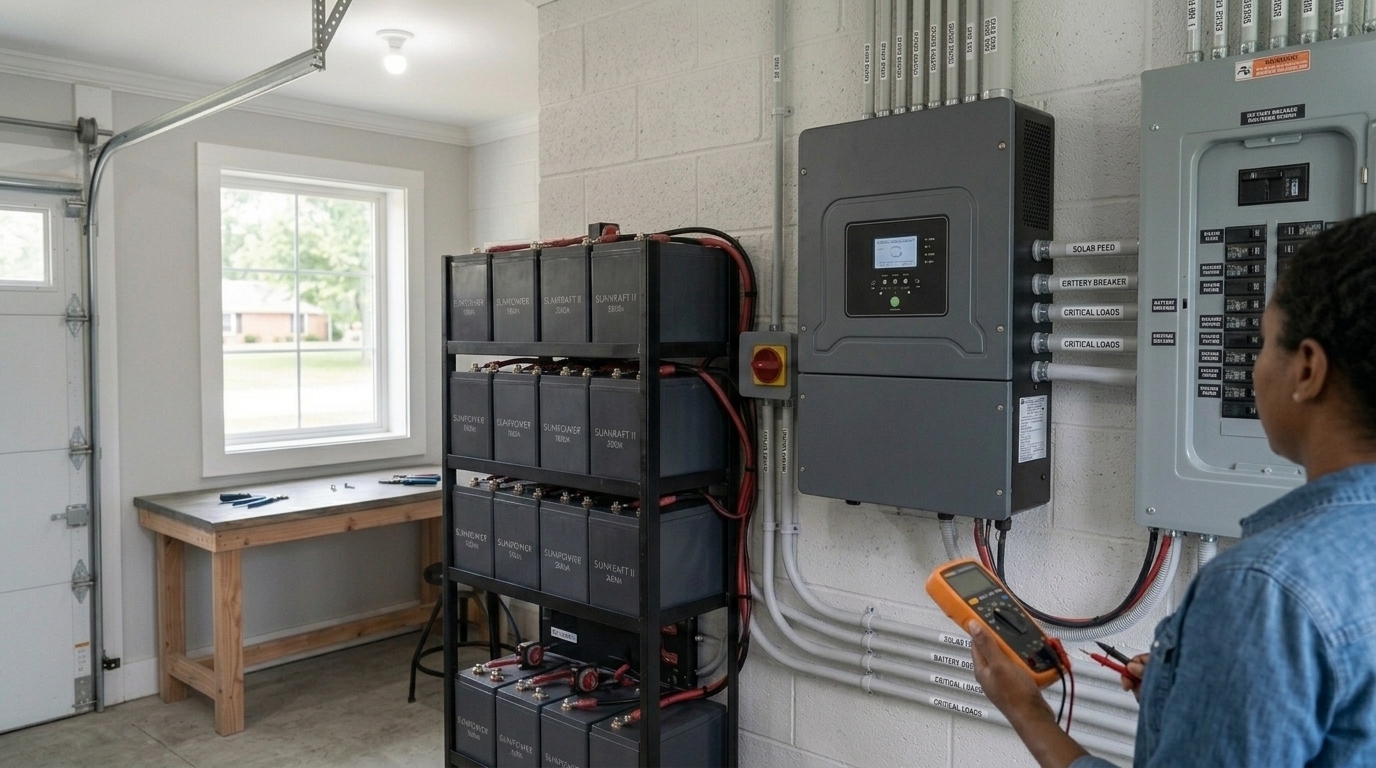
Trying to achieve this with portable power stations would cost 3-4x as much and leave you with separate units that don’t integrate with each other or your home’s electrical panel.
Large Capacity Needs (10+ kWh)
Portable power stations max out at about 6 kWh per unit. You can chain some models (EcoFlow Delta Pro supports up to two extra batteries for 10.8 kWh total), but you’re paying a premium for every kWh and running into physical limits.
DIY systems scale to whatever you need. My current battery bank is 10.4 kWh (two EG4 LL-S 48V 100Ah batteries). I can add more batteries at any time — the inverter supports them, the wiring accommodates expansion, and the cost per additional kWh is just the battery price. For battery selection advice, see the best LiFePO4 batteries comparison.
Expandability Over Time
This is the DIY advantage that takes a while to appreciate. When I first built my system, I started with 5.2 kWh of storage and 2 kW of panels. Six months later, I added another battery. Three months after that, I added two more panels. Each expansion was straightforward and cost only the new components.
Portable systems are essentially fixed. Some support expansion batteries from the same manufacturer, but you can’t mix brands, you can’t upgrade the inverter, and you can’t swap in higher-capacity cells in three years when prices drop. You buy the box, and that’s what you get.
Cost Efficiency Over 5+ Years
When you factor in the federal tax credit (30% for DIY installations in 2026), the effective cost per kWh for a DIY system drops even further. A 10 kWh system at $4,000 before the credit becomes $2,800 after — that’s $280/kWh including the inverter and all components. At the battery-only level, you’re looking at $70-100/kWh effective cost.
Portable power stations don’t qualify for the federal solar tax credit because they’re consumer electronics, not permanent solar energy property. That 30% difference is significant on any system over $1,000.
Off-Grid Living
If you’re off-grid — no utility connection — a portable power station is a stopgap, not a solution. You need a system that can handle sustained daily loads of 10-30+ kWh, charge from a panel array sized to your consumption, and run continuously for years without intervention beyond basic maintenance.
That’s a DIY system. It’s designed for exactly this purpose.
Popular Portable Options: Quick Takes
Here’s my honest assessment of the most popular portables in 2026.
EcoFlow Delta Pro ($1,799 / 3.6 kWh)
The default recommendation and for good reason. 3,600W output handles most household loads including a fridge and microwave simultaneously. Smart home panel integration lets you connect it to specific circuits in your breaker box (though installation isn’t trivial — it requires an electrician or confident DIYer). Expandable to 10.8 kWh with two extra batteries at $2,200 total.
Downside: The app pushes firmware updates that have occasionally introduced bugs. The expansion batteries at $1,099 each ($305/kWh) make scaling expensive. Fan noise under load is noticeable in a quiet room.
Bluetti AC200MAX ($1,299 / 2.05 kWh)
Solid mid-range option. 2,200W output is enough for most essentials but won’t run a large AC unit. Supports two expansion batteries (B230 or B300) for up to 8.2 kWh total. Built-in 900W solar input is generous for a portable.
Downside: The proprietary expansion connector means you’re locked into Bluetti’s ecosystem. The base unit at $634/kWh is expensive for the capacity. The touchscreen interface is sluggish.
Jackery Explorer 2000 Plus ($1,299 / 2.04 kWh)
Jackery has improved significantly from their earlier models. The 2000 Plus supports up to 5 add-on battery packs for a total of 12.3 kWh, which is the highest expansion ceiling in the portable category. 3,000W output is respectable.
Downside: The expansion batteries are $899 each ($440/kWh). At full expansion (12.3 kWh, ~$5,800), you’re deep into the territory where a DIY system would cost half as much and perform better.
The “Gateway Drug” Effect
Here’s a pattern I see constantly in the DIY solar community: someone buys a portable power station — often after a power outage that lasted longer than their phone battery. They use it, like it, and start thinking bigger. “What if I could run the whole house?” “What if I could charge this faster?”
They price out scaling the portable system. Three expansion batteries for the EcoFlow Delta Pro: $3,300. For that money, they could buy a 10 kWh DIY battery bank and an MPPT charge controller. The lightbulb goes off.
Six months later, they have a full DIY system in the garage and the portable lives in the camping gear closet. I’ve watched many people in the community follow this exact trajectory.
This isn’t a knock on portables — they’re an excellent introduction to solar energy storage. You learn the basics (watt-hours, charge rates, solar input, load management) in a forgiving environment where the worst mistake is running out of juice on a camping trip. That knowledge transfers directly when you step up to DIY.
If you’re in this transition and ready to start building, the getting started guide is specifically written for people making this jump.
When to Mix Both: Portable + DIY
This is what I do, and I think it’s the smartest approach for anyone who camps or travels.
At home: The DIY system handles everything. 10.4 kWh of LiFePO4 batteries, 4 kW of panels on the roof, EG4 6000XP inverter powering the house. It runs 24/7, charges daily from solar, and carries us through overnight and through outages. The whole system cost about $4,500 before the tax credit.
On the road: A portable power station rides in the truck. 2 kWh of portable power for camping, tailgating, or working from a remote location. It charges from a 200W folding panel during the day or from the truck’s 12V outlet while driving.
They don’t overlap. The portable doesn’t come into the house for backup — the DIY system handles that far better. And I don’t try to make the DIY system portable — that would be a heavy, fragile, exposed-wiring mess.
Budget approach: If you can only afford one thing right now, buy a portable ($500-1,500 range) and use it while you plan and save for a DIY build. The portable gives you immediate emergency backup, and you’ll learn how much power you actually use — data that’s valuable when sizing a permanent system.
Hybrid scenario: Some people use a portable as a “circuit extender” for their DIY system. A portable in the bedroom provides backup for CPAP machines without running dedicated circuits from the inverter panel. A portable in a detached workshop avoids the cost of trenching wire from the house. These are valid uses where the portable’s self-contained design is actually the advantage.
The Comparison Table
| Factor | Portable Power Station | DIY Solar System |
|---|---|---|
| Cost per kWh | $400-650/kWh | $100-250/kWh |
| Setup time | Minutes | Days to weeks |
| Electrical knowledge needed | None | Intermediate |
| Portability | Excellent | None |
| Max practical capacity | 6-12 kWh | Unlimited |
| Expandability | Limited, brand-locked | Open, mix components |
| Lifespan | 5-10 years (sealed unit) | 10-15+ years (replaceable parts) |
| Repairability | Minimal (sealed) | Full (every component accessible) |
| Federal tax credit eligible | No | Yes (30% in 2026) |
| Grid integration | Limited | Full (with hybrid inverter) |
| Whole-house backup | No (except Delta Pro + smart panel) | Yes |
| Best for | Camping, apartments, small backup | Home backup, off-grid, cost savings |
Making Your Decision
Buy a portable if:
- You need power away from home (camping, RV, tailgating, remote work)
- You rent and can’t modify the property
- You want emergency backup for a few essentials with zero installation
- You don’t want to learn about electrical systems
- Your total backup need is under 5 kWh
Build DIY if:
- You own your home and want permanent solar
- You need more than 5-10 kWh of storage
- You want the lowest long-term cost per kWh
- You want a system you can expand and upgrade over time
- You want to qualify for the federal solar tax credit
- You enjoy (or are willing to learn) hands-on technical projects
- You want whole-house backup or off-grid capability
Buy both if:
- You want home backup AND portable power for travel
- You’re starting with a portable now and planning to build DIY later
- You have specific portable needs (CPAP backup, detached workshop) alongside a home system
The right answer depends on your situation, not on which technology is “better.” A $1,500 EcoFlow in an apartment beats a $5,000 DIY system you can’t install. And a $3,000 DIY system in a house you own beats $6,000 worth of portable expansion batteries trying to match the same capacity.
For those ready to take the DIY path, start with the Solar System Sizer to figure out how much capacity you actually need, then work through the getting started guide for the full build process. If batteries are your first purchase, the best LiFePO4 batteries for 2026 covers the top picks at every price point.
Frequently Asked Questions
Is a portable power station or DIY solar cheaper?
DIY solar is significantly cheaper at scale. Portable power stations cost $400-650 per kWh of storage, while DIY systems cost $100-250 per kWh. At 10 kWh and above, DIY costs under $150/kWh while portable options (if they can even reach that capacity) cost $350-500/kWh.
Do portable power stations qualify for the federal solar tax credit?
No. Portable power stations are classified as consumer electronics and do not qualify for the 30% federal solar tax credit. DIY solar installations on your primary or secondary residence do qualify, making the effective cost difference even larger.
Can a portable power station run a whole house?
Generally no. Most portable power stations max out at 3-6 kWh of storage and 3,600W of output — enough for a fridge and some lights but not a whole house. DIY systems can scale to 20+ kWh with 6-15kW of output for whole-home backup.
Should I start with a portable power station before building DIY solar?
A portable power station is a good introduction. You learn the basics of watt-hours, charge rates, and load management in a forgiving environment. Many people start with a portable and graduate to DIY once they realize they need more capacity or lower per-kWh costs.
What is the best portable power station for emergency backup?
The EcoFlow Delta Pro (3.6 kWh, $1,799) is the default recommendation for home emergency backup. It handles 3,600W of output, supports expansion batteries, and has smart home panel integration for connecting to specific circuits in your breaker box.
Anthony
Solar homeowner, EV driver, and DIY builder. Using solar to power a large part of my home.
Get build guides in your inbox
Weekly solar builds, product tests, and technical deep-dives.
Subscribe Free