Understanding the 30% Federal Solar Tax Credit (ITC) in 2026

Quick answer: The federal Investment Tax Credit (ITC) lets you deduct 30% of your total solar system cost directly from your federal income taxes. For a $12,000 DIY system, that’s a $3,600 credit. The 30% rate is locked in through 2032. If you’re doing a DIY install, your materials qualify — your labor doesn’t (but you weren’t paying yourself anyway).
What the ITC Actually Is
The ITC is a dollar-for-dollar tax credit, not a deduction. That distinction matters. A $3,600 tax deduction might save you $800-900 depending on your bracket. A $3,600 tax credit reduces your tax bill by the full $3,600.
This credit was extended and enhanced by the Inflation Reduction Act (IRA) of 2022. Before the IRA, the credit was scheduled to phase down. Now the timeline looks like this:
| Tax Year | Credit Rate |
|---|---|
| 2022-2032 | 30% |
| 2033 | 26% |
| 2034 | 22% |
| 2035+ | 0% (residential; commercial keeps 10%) |
You have until the end of 2032 to install at the full 30% rate. The credit applies to the year your system is placed in service — meaning installed and operational, not just purchased.
What Qualifies for the Credit
This is where people either leave money on the table or get into trouble. Here’s what counts and what doesn’t, based on IRS guidance and Section 25D of the tax code.
Qualified Expenses
Solar panels — The panels themselves, obviously. This includes rigid panels, flexible panels, and building-integrated photovoltaics (BIPV). If it converts sunlight to electricity and it’s part of your system, it counts.
Inverters — String inverters, microinverters, hybrid inverters. All qualify. If you buy a hybrid inverter that also manages battery charging, the full cost of the inverter counts.
Charge controllers — MPPT or PWM, both qualify as part of the solar electric system.
Battery storage — This is a big one the IRA added. Battery storage qualifies on its own as of 2023, even if installed separately from panels. The battery must have at least 3 kWh of capacity. This is a big reason grid-tied systems with battery backup have taken off since the IRA passed — homeowners can add storage to an existing array and still get the full 30% credit. LiFePO4, lithium-ion, even lead-acid banks that meet the capacity threshold. If you’re deciding which batteries to buy, our best LiFePO4 batteries for 2026 comparison covers the top options and their real-world costs per kWh.
Racking and mounting hardware — Roof mounts, ground mount frames, pole mounts, tilt brackets, rail systems, clamps, flashing. All of it.
Wiring and electrical components — Wire, conduit, fittings, junction boxes, combiner boxes, disconnects, breakers, fuses, MC4 connectors, cable management clips. Every electrical component that’s part of the solar installation qualifies.
Monitoring equipment — If you buy a monitoring system (Victron Cerbo GX, for example) as part of the solar installation, it qualifies.
Permit and inspection fees — The cost of pulling electrical permits and any required inspections.
Sales tax on qualifying equipment — Often overlooked. The sales tax you pay on all the qualifying equipment above is also part of the qualified cost basis.
Installation labor — If you hire an electrician to do your final AC connections, their labor charge qualifies. If you hire someone to install your ground mount, that labor qualifies. Professional installation costs are fully includable.
What Does NOT Qualify
Your own labor — If you do the work yourself, you can’t assign a dollar value to your time and claim it. The materials qualify; your sweat equity doesn’t. But the whole point of DIY is saving on that labor cost anyway.
Utility panel upgrades — If you need to upgrade your main electrical panel from 100A to 200A service to accommodate solar, that upgrade cost is generally not part of the solar credit. It’s a general home improvement. However, if a sub-panel is installed specifically for the solar system, that may qualify — consult a tax professional on this one.
Land or site preparation — Clearing trees, pouring a concrete pad for a ground mount, grading your yard. These are typically not qualified expenses. The ground mount hardware itself qualifies, but the civil work to prepare the site usually doesn’t.
Roof repairs or replacement — If you re-roof before installing panels, that’s not a solar expense. The solar mounting hardware that attaches to the roof qualifies, but the roofing materials don’t.
Grid connection fees — Utility interconnection fees, net metering application fees, and similar utility charges are generally not qualified ITC expenses.
Purely aesthetic items — Critter guards, conduit paintwork, or decorative panel skirts may be a gray area. If it’s functional (critter guards arguably are), you may have a case. If it’s cosmetic, probably not.
How to Claim the ITC: Step by Step
Step 1: Gather Your Documentation
Keep every receipt. Every single one. I organize mine in a folder by category:
- Panels
- Batteries
- Inverter/charge controller
- Wiring and electrical
- Mounting hardware
- Permits
- Professional labor (if any)
You don’t submit receipts with your tax return, but you need them if the IRS ever asks. Keep them for at least 7 years.
Step 2: Add Up Your Qualified Costs
Total everything from the “qualified expenses” list above. For a worked example:
| Component | Cost |
|---|---|
| 8× 400W solar panels | $2,400 |
| MPPT charge controller | $450 |
| 48V 100Ah LiFePO4 battery (×2) | $2,200 |
| Hybrid inverter (5kW) | $1,800 |
| Racking and mounting | $1,200 |
| Wiring, conduit, breakers, disconnects | $950 |
| Permit and inspection | $400 |
| Electrician for AC tie-in | $600 |
| Sales tax | $700 |
| Total qualified cost | $10,700 |
Step 3: Calculate Your Credit
$10,700 × 0.30 = $3,210
Step 4: File IRS Form 5695

The form is straightforward:
- Enter your qualified solar electric property costs on Line 1
- Multiply by 0.30 on Line 6b (for installations in 2022-2032)
- The credit amount flows to Line 15, then to your Form 1040, Schedule 3, Line 5
That credit directly reduces the federal income tax you owe, dollar for dollar.
Step 5: Handle the Carry-Forward (If Needed)
Here’s something critical that many people miss: the ITC is non-refundable. That means it can reduce your tax liability to zero, but it won’t generate a refund beyond what you’ve already paid in.
Example: Your federal tax liability for 2026 is $2,500, and your calculated ITC is $3,210. You’d use $2,500 of the credit this year (reducing your tax to $0) and carry forward the remaining $710 to 2027.
The unused credit carries forward to future tax years — there is no published expiration on the carryforward for the Section 25D residential credit. Check the current year’s Form 5695 instructions to confirm details for your filing year.
Planning tip: If your tax liability is typically low, consider timing your installation in a year where you have higher income (bonus, asset sale, Roth conversion, etc.) to maximize the credit in a single year. When I installed my system, I intentionally did it in a year I knew my tax bill would be higher.
DIY-Specific Considerations
Materials Qualify, Your Time Doesn’t
This bears repeating because it’s the number one question I get. If you buy $8,000 in equipment and do all the work yourself, your qualified cost is $8,000. You can’t add $4,000 for “labor I would have paid someone else.” The IRS doesn’t care about hypothetical costs.
Keep It Residential
The Section 25D credit is for your primary or secondary residence. This includes a house you own and live in, a vacation home you own, and — this trips people up — certain mobile homes and houseboats if they’re your residence.
It does not apply to rental properties. If you’re a landlord installing solar on a rental, you’d look at the Section 48 commercial credit instead, which has different rules.
New Construction Counts
If you’re building a new home and including solar from the start, the solar components qualify. You don’t need to install panels on an existing home first.
No Income Cap
Unlike some state incentives and the EV tax credit, the federal solar ITC has no income limit. Whether you earn $40,000 or $400,000, you get the same 30% credit. This is one of the simplest and most generous federal energy incentives available.
Common Mistakes People Make
These errors come up repeatedly in DIY solar forums:
1. Not Claiming the Credit at All
Some DIY builders don’t realize their self-installed system qualifies. If you bought the equipment and installed it on your residence, you qualify. There’s no requirement to use a licensed contractor.
2. Forgetting Battery Storage
Since the IRA expanded the credit to standalone battery storage, people sometimes claim the panel credit but forget to include their battery bank. If you installed batteries with 3+ kWh total capacity, include them.
3. Mixing Up Tax Year and Purchase Year
The credit applies to the year the system was placed in service — operational and producing power. If you bought panels in December 2025 but didn’t finish installation until February 2026, you claim it on your 2026 return.
4. Not Including All Qualified Costs
People often remember to claim panels and batteries but forget about wire, conduit, breakers, permits, and sales tax. On a $10,000+ system, those “small” items can add up to $1,000-2,000 in additional qualified costs, which means $300-600 more in credit. That’s real money.
5. Confusing the Credit with a Deduction
I’ve heard people say “I’ll save 30% of my solar costs on my taxes” and then calculate it as a deduction rather than a credit. A $3,600 credit saves you exactly $3,600 in taxes. A $3,600 deduction at a 22% bracket saves you only $792. The credit is far more powerful.
6. Not Keeping Receipts
If audited, you need to prove your qualified costs. A bank statement showing a $3,000 charge to “Amazon” isn’t sufficient. Keep itemized receipts that show exactly what you bought. For online orders, save the order confirmation emails and invoices. When I bought components over several months, I created a spreadsheet tracking every purchase with the date, vendor, item description, and amount.
State Credits and Incentives Stack
The federal ITC isn’t the only game in town. Many states offer their own credits, rebates, or incentives that stack on top of the federal credit. Some examples:
- State tax credits (percentage or flat dollar amount)
- Utility rebate programs (per-watt installed)
- State renewable energy certificates (SRECs)
- Property tax exemptions for solar improvements
- Sales tax exemptions on solar equipment
Check the DSIRE database (Database of State Incentives for Renewables & Efficiency) for what’s available in your state. Some state incentives require specific equipment or certified installers, so read the fine print before assuming your DIY system qualifies.
Important note: State rebates generally reduce your federal qualified cost basis. If you receive a $1,000 state rebate, your federal qualified cost is reduced by $1,000 before calculating the 30% credit. State tax credits typically do not reduce the federal basis, but confirm with a tax professional.
A Worked Example: Full System
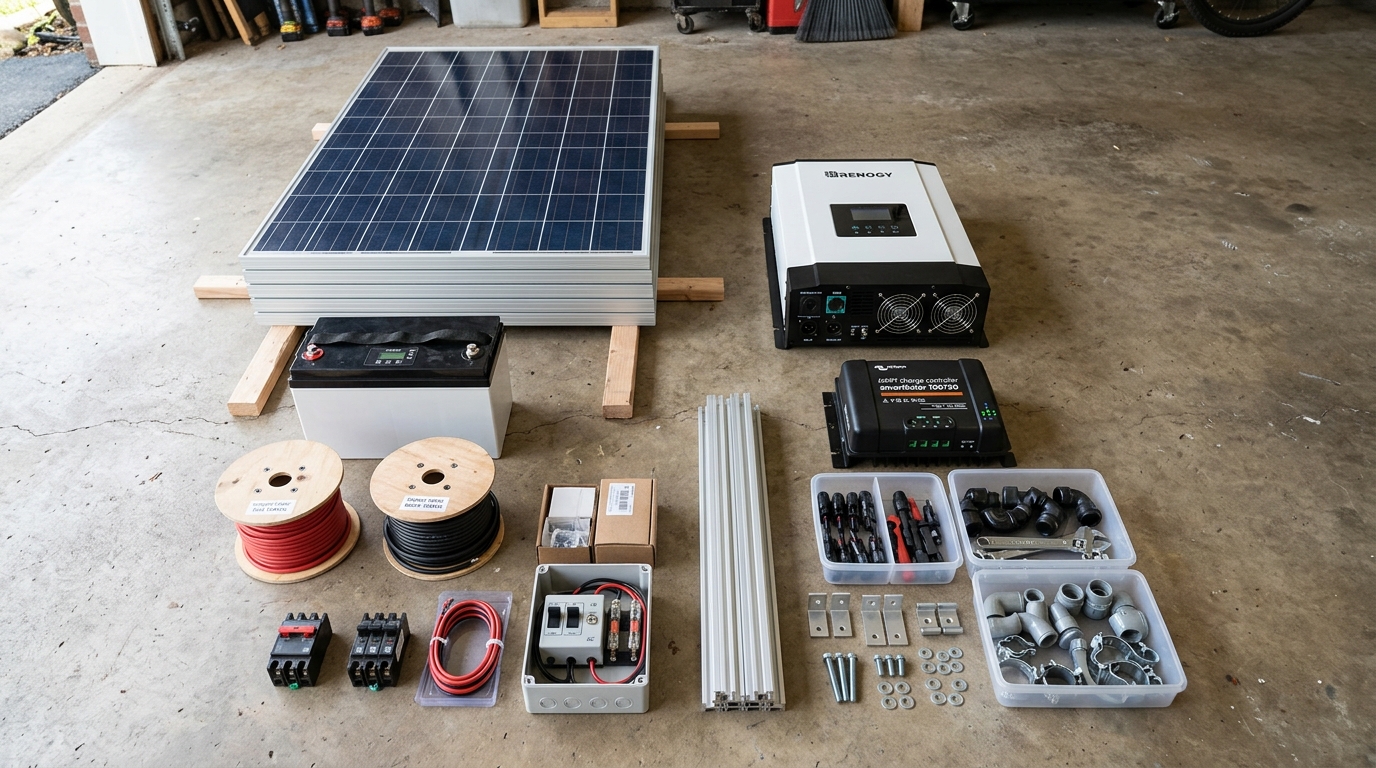
Here’s a realistic scenario for a 2026 DIY installation. You can estimate your own costs with our Cost Estimator.
System: 3.2 kW ground-mounted array with 10 kWh LiFePO4 battery bank, 48V hybrid inverter
| Item | Cost |
|---|---|
| 8× 400W panels | $2,400 |
| Ground mount system | $1,400 |
| 48V 200Ah LiFePO4 battery | $3,800 |
| 5kW hybrid inverter | $1,800 |
| MPPT charge controller | $500 |
| Wiring (150 ft 6 AWG, 50 ft 4 AWG, misc) | $480 |
| Electrical: breakers, disconnects, combiner | $320 |
| Conduit and fittings | $250 |
| Monitoring (Victron Cerbo GX + touchscreen) | $450 |
| Permits and inspection | $350 |
| Electrician final AC connection | $250 |
| Subtotal | $12,000 |
| Sales tax (varies by state, ~6%) | $680 |
| Total qualified cost | $12,680 |
Federal ITC: $12,680 × 0.30 = $3,804
That’s $3,804 directly off your federal tax bill. If you used our Cost Estimator during the planning phase, you’d see this credit reflected in the net system cost calculation.
For help sizing a system that hits the right balance of cost and output, start with the Solar System Sizer.
Disclaimer
I’m a solar hobbyist, not a CPA or tax attorney. Tax law is complicated and individual situations vary. The information above is based on my understanding of the Inflation Reduction Act and IRS guidance as of early 2026. For decisions involving significant tax credits, consult a qualified tax professional who can review your specific situation. The IRS publication 5797 and Form 5695 instructions are the authoritative sources.
If you’re ready to plan your system, our DIY LiFePO4 battery bank guide walks through building a battery bank from raw cells — every component you purchase qualifies for the ITC. And for a full cost picture including the tax credit, run your numbers through the Cost Estimator.
Frequently Asked Questions
Does the federal solar tax credit apply to DIY installations?
Yes. All equipment and materials you purchase qualify — panels, batteries, inverters, wiring, mounting hardware, permits, and even sales tax. Your own labor does not qualify, but you were not paying yourself anyway. There is no requirement to use a licensed contractor.
How long is the 30% solar tax credit available?
The 30% rate is locked in through 2032 under the Inflation Reduction Act. It drops to 26% in 2033, 22% in 2034, and expires for residential in 2035. The credit applies to the year your system is placed in service (operational), not the year you purchased components.
Do batteries qualify for the solar tax credit?
Yes. The IRA expanded the credit to include battery storage with at least 3 kWh of capacity, even if installed separately from solar panels. LiFePO4, lithium-ion, and lead-acid banks all qualify as long as they meet the capacity threshold.
Is the solar tax credit a deduction or a credit?
It is a dollar-for-dollar tax credit, not a deduction. A $3,600 credit reduces your tax bill by exactly $3,600. A deduction of the same amount at a 22% tax bracket would only save $792. The credit is far more valuable.
What happens if the solar tax credit is more than I owe in taxes?
The ITC is non-refundable — it can reduce your tax liability to zero but will not generate a refund. Any unused credit carries forward to future tax years until fully used. There is no published expiration on the carryforward.
Anthony
Solar homeowner, EV driver, and DIY builder. Using solar to power a large part of my home.
Get build guides in your inbox
Weekly solar builds, product tests, and technical deep-dives.
Subscribe Free